Peptide Quick Guide: Understanding Common Research Compounds
The field of peptide research has expanded significantly over the past decade, with scientists investigating how naturally occurring signaling molecules influence metabolism, tissue repair, cellular communication, and neurological function. Alongside peptides, compounds such as NAD+ and Glutathione have also become popular subjects of laboratory research because of their roles in cellular energy production and antioxidant defense.
This quick guide introduces several of the most commonly studied research compounds and explains the biological systems they are most often associated with in laboratory settings.
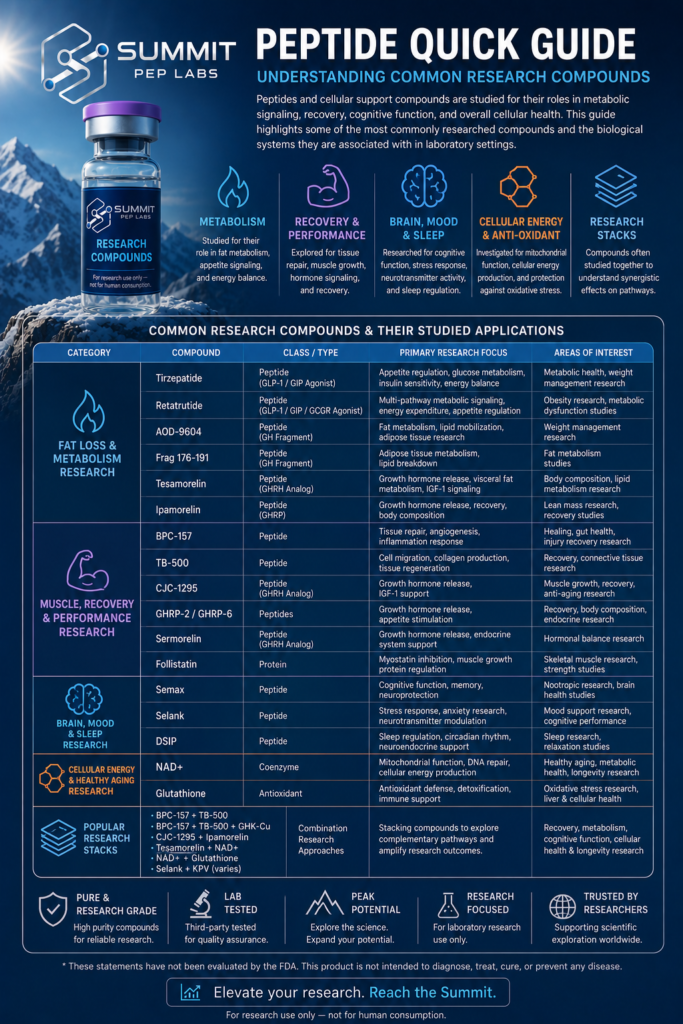
Fat Loss & Metabolism Research
One of the largest areas of peptide research focuses on metabolism, energy balance, and body composition.
Compounds such as Tirzepatide and Retatrutide are widely studied for their interaction with multiple metabolic hormone receptors involved in appetite regulation, glucose metabolism, and energy expenditure. Researchers continue to investigate how these signaling pathways influence body weight and overall metabolic function.
Other peptides including AOD-9604 and Frag 176-191 are commonly explored for their relationship with fat metabolism and adipose tissue biology, making them frequent subjects in obesity and metabolic research.
Tesamorelin is another peptide of significant research interest. As a growth hormone-releasing hormone (GHRH) analog, it is studied for its effects on endogenous growth hormone secretion and downstream IGF-1 signaling. Research often examines Tesamorelin in relation to body composition, visceral fat metabolism, lipid regulation, and cellular metabolic processes.
Peptides such as Ipamorelin are also frequently investigated for their selective stimulation of growth hormone pathways while minimizing effects on other endocrine hormones.
Muscle, Recovery & Performance Research
Recovery and tissue regeneration represent another major focus of peptide research.
BPC-157 and TB-500 are among the most extensively discussed peptides in studies examining tissue repair, angiogenesis, collagen production, inflammation, and cellular regeneration. Researchers continue to explore how these compounds interact with various healing pathways across multiple tissue types.
Growth hormone secretagogues including CJC-1295, Ipamorelin, GHRP-2, GHRP-6, and Sermorelin are commonly studied for their ability to stimulate natural growth hormone release and support investigations into recovery, protein synthesis, and body composition.
Follistatin is another research peptide frequently examined for its role in regulating myostatin, a protein involved in limiting muscle growth. Because of this mechanism, it has become an important subject in studies involving skeletal muscle development and protein regulation.
Cellular Energy & Healthy Aging Research
Beyond peptides, researchers have increasingly focused on compounds involved in cellular energy production and oxidative stress.
NAD+ (Nicotinamide Adenine Dinucleotide) is an essential coenzyme found in every living cell. Laboratory research investigates its role in mitochondrial energy production, DNA repair, cellular signaling, and age-related biological processes. Because NAD+ levels naturally decline over time, scientists continue to study how maintaining cellular NAD+ may influence metabolic health, mitochondrial efficiency, and healthy aging.
Glutathione is one of the body’s primary intracellular antioxidants and plays an important role in maintaining redox balance within cells. Research commonly explores Glutathione’s involvement in neutralizing reactive oxygen species, supporting detoxification pathways, protecting mitochondria, and reducing oxidative stress. Its role in cellular defense makes it a frequent subject in studies involving liver function, immune response, recovery, and overall cellular health.
Although NAD+ and Glutathione are not peptides, they are often discussed alongside peptide research because of their complementary roles in supporting cellular metabolism and biological resilience.
Brain, Mood & Sleep Research
Peptides also play an important role in neuroscience and cognitive research.
Compounds such as Semax and Selank are frequently investigated for their effects on neurotransmitter activity, cognitive performance, learning, memory, and stress response. Researchers continue exploring how these peptides may influence communication between neurons and adaptive neurological processes.
DSIP (Delta Sleep-Inducing Peptide) is another compound commonly studied for its relationship with sleep regulation, circadian rhythm, and neuroendocrine signaling.
Rather than functioning independently, these peptides are typically examined within broader research exploring the complex interactions between the nervous system and cellular signaling molecules.
Popular Research Combinations (“Stacks”)
Researchers often study multiple compounds together to better understand how complementary biological pathways interact.
Examples commonly discussed include:
- BPC-157 + TB-500 for tissue repair and recovery research
- BPC-157 + TB-500 + GHK-Cu for broader connective tissue and skin-related investigations
- CJC-1295 + Ipamorelin for growth hormone signaling research
- Tesamorelin + NAD+ in research examining metabolic health, mitochondrial function, and body composition
- NAD+ + Glutathione in studies focused on cellular energy production, oxidative stress, and mitochondrial support
- More specialized combinations may also include compounds such as Selank, KPV, or MOTS-C, depending on the biological pathways being investigated.
These combinations are intended for research purposes only and are not standardized protocols.
Final Thoughts
Research peptides, along with compounds such as NAD+ and Glutathione, continue to represent an evolving area of scientific investigation. Ongoing laboratory studies are expanding our understanding of how these molecules participate in cellular signaling, metabolism, tissue repair, neurological function, and mitochondrial health.
While early findings have generated significant scientific interest, many mechanisms remain under investigation. As research progresses, these compounds continue to provide valuable insight into the complex biological systems that regulate human physiology.
Disclaimer: All products discussed are intended for laboratory research purposes only. They are not approved for human consumption, and statements regarding these compounds have not been evaluated by the U.S. Food and Drug Administration. They are not intended to diagnose, treat, cure, or prevent any disease.