⚡ NAD+ Research Guide
Why NAD+ Continues to Gain Attention in Longevity & Cellular Energy Research
Research Use Only
NAD+ (Nicotinamide Adenine Dinucleotide) is widely studied in laboratory settings for its central role in cellular metabolism, mitochondrial biology, and energy production. This article is intended for educational and research purposes only.
🧬 What Is NAD+?
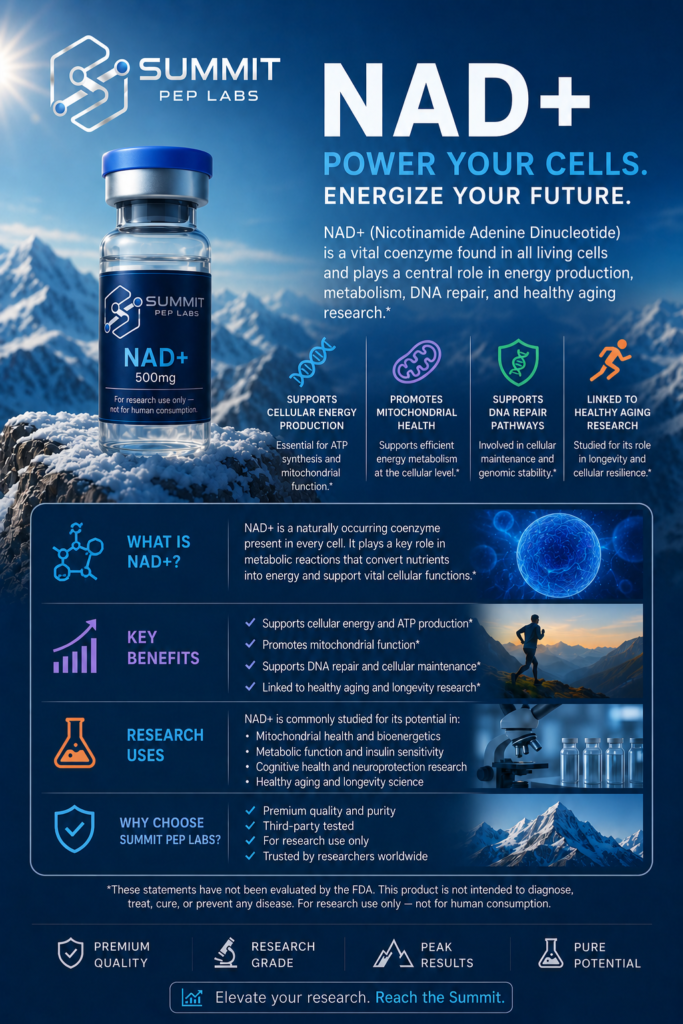
Nicotinamide Adenine Dinucleotide (NAD+) is a naturally occurring coenzyme present in virtually every living cell. It serves as one of the body’s most important molecules for converting nutrients into usable cellular energy while also supporting numerous biological signaling pathways.
Without sufficient NAD+, cells cannot efficiently perform many of the metabolic reactions necessary for normal cellular function.
Researchers continue studying NAD+ because it participates in hundreds of enzymatic reactions throughout the body, particularly those involving:
- ⚡ Cellular energy production
- 🔋 ATP synthesis
- 🧬 DNA repair pathways
- 🛡️ Oxidative stress response
- 🔄 Cellular metabolism
- 🧠 Mitochondrial function
- ⏳ Healthy aging research
Because of these broad biological roles, NAD+ has become one of the most extensively researched compounds in modern longevity science.
🔬 Why Researchers Study NAD+
NAD+ functions as a critical coenzyme during metabolic reactions that allow cells to generate energy from carbohydrates, fats, and proteins.
Scientists frequently investigate NAD+ for its involvement in:
- 🧬 Mitochondrial efficiency
- ⚡ Cellular ATP production
- 🔄 Energy metabolism
- 🛡️ Oxidative stress regulation
- 🧪 Redox signaling
- 🔧 DNA maintenance and repair
- 🧠 Cellular communication pathways
- 📉 Age-related metabolic decline
One of the primary reasons NAD+ attracts so much attention is that naturally occurring cellular NAD+ levels appear to decrease over time, making it an important focus in healthy aging research.
⚡ NAD+ and Mitochondrial Function
Mitochondria are often referred to as the “powerhouses of the cell.” Their primary responsibility is producing ATP—the molecule that powers nearly every cellular process.
NAD+ plays an essential role throughout this process by participating in:
- Electron transport chain activity
- Oxidation-reduction (redox) reactions
- Krebs (Citric Acid) Cycle metabolism
- ATP generation
- Cellular respiration
- Metabolic flexibility
Researchers continue investigating how NAD+ availability influences mitochondrial efficiency and overall cellular energy production.
As mitochondria become less efficient with age, NAD+ has become a major area of investigation in bioenergetics and metabolic research.
🧬 NAD+ and DNA Repair
Beyond energy production, NAD+ also supports enzymes involved in maintaining genomic integrity.
Researchers commonly study NAD+ because it serves as a necessary cofactor for enzymes such as PARPs (Poly ADP-Ribose Polymerases) that participate in DNA repair pathways following normal cellular damage.
Current research continues exploring NAD+’s relationship with:
- DNA maintenance
- Cellular stress responses
- Genome stability
- Healthy cellular aging
- Repair signaling pathways
Maintaining these pathways has become an important area of longevity-focused scientific investigation.
🧠 NAD+ and Sirtuin Research
One of the most widely discussed areas of NAD+ research involves sirtuins—a family of proteins that depend on NAD+ to function.
Researchers study sirtuins because they are involved in:
- 🧬 Cellular stress adaptation
- 🔄 Metabolic regulation
- 🧠 Mitochondrial health
- 🔋 Energy sensing
- 🛡️ Cellular resilience
- ⏳ Biological aging research
Because sirtuin activity requires NAD+, many longevity studies investigate how cellular NAD+ availability may influence these pathways.
📈 Why NAD+ Levels Matter
Scientists have observed that intracellular NAD+ concentrations may gradually decline with age.
This natural decline has generated significant research interest regarding potential effects on:
| Cellular Process | Research Interest |
|---|---|
| ⚡ ATP Production | Cellular energy metabolism |
| 🔋 Mitochondrial Function | Bioenergetics research |
| 🧬 DNA Repair | Genome maintenance |
| 🛡️ Oxidative Stress | Cellular protection pathways |
| 🔄 Metabolic Health | Metabolic flexibility |
| ⏳ Healthy Aging | Longevity science |
Researchers continue investigating whether maintaining healthy NAD+ metabolism may support normal cellular function throughout aging.
🔬 NAD+ in Longevity Research
NAD+ has become one of the most recognizable molecules in longevity science.
It frequently appears in studies involving:
- Healthy aging
- Cellular resilience
- Bioenergetics
- Metabolic flexibility
- Mitochondrial biology
- Cellular signaling
- DNA maintenance
- Stress response pathways
Interest in NAD+ has expanded substantially as researchers continue exploring the biological mechanisms underlying aging.
🚀 Growing Interest in NAD+ Research
Over the past several years, NAD+ has become increasingly associated with discussions involving:
- NMN (Nicotinamide Mononucleotide)
- NR (Nicotinamide Riboside)
- Mitochondrial optimization
- Cellular bioenergetics
- Longevity science
- Healthy aging research
- Performance-focused metabolic studies
While each compound is studied differently, they all share an interest in understanding cellular NAD+ metabolism.
🤝 NAD+ and Combination Research
Researchers often evaluate NAD+ alongside other research compounds to investigate complementary biological pathways.
Common research combinations include:
| Research Compound | Area of Scientific Interest |
|---|---|
| MOTS-c | Mitochondrial metabolism |
| GHK-Cu | Tissue remodeling and cellular signaling |
| Semax | Neurobiology research |
| NMN | NAD+ biosynthesis pathways |
| NR | Cellular NAD+ precursor research |
| Glutathione | Oxidative stress and antioxidant systems |
Combination studies typically investigate broader interactions involving:
- Cellular resilience
- Energy metabolism
- Recovery-related pathways
- Oxidative stress response
- Mitochondrial communication
💧 NAD+ Reconstitution Overview
Researchers commonly reconstitute lyophilized NAD+ using sterile bacteriostatic water under controlled laboratory conditions.
Example Calculation
| Vial Size | Bacteriostatic Water | Final Concentration |
|---|---|---|
| 500 mg | 5 mL | 100 mg/mL |
| 1000 mg | 10 mL | 100 mg/mL |
Researchers should always verify concentration calculations independently and follow appropriate sterile laboratory procedures throughout preparation.
❄️ Storage & Handling
To help preserve compound stability, researchers generally recommend:
✅ Store in cool, temperature-stable conditions
✅ Refrigerate after reconstitution
✅ Protect from excessive heat and direct light
✅ Use sterile laboratory handling techniques
✅ Minimize repeated contamination during preparation
Proper storage practices may contribute to maintaining compound integrity throughout the research process.
📊 Quick NAD+ Research Summary
| Feature | NAD+ |
|---|---|
| Full Name | Nicotinamide Adenine Dinucleotide |
| Primary Role | Cellular energy coenzyme |
| Research Areas | Longevity, metabolism, mitochondria |
| Associated Pathways | ATP production, DNA repair, sirtuins |
| Cellular Location | Present in virtually all living cells |
| Common Research Topics | Healthy aging, oxidative stress, bioenergetics |
🌎 Why NAD+ Continues to Trend in 2026
Interest in NAD+ research continues to expand due to growing scientific attention surrounding:
- 🧬 Longevity biology
- ⚡ Mitochondrial health
- 🔋 Cellular energy production
- 🛡️ Healthy aging research
- 🧠 Biohacking communities
- 🔄 Metabolic optimization
- 📚 Cellular signaling research
As our understanding of aging biology advances, NAD+ remains one of the foundational molecules studied across numerous fields of biomedical research.
🏁 Final Thoughts
NAD+ continues to be one of the most extensively studied molecules in modern cellular biology because of its essential role in energy metabolism, mitochondrial function, and intracellular signaling.
Its involvement in ATP production, redox reactions, DNA repair mechanisms, and sirtuin-dependent pathways has made it a cornerstone of contemporary longevity research.
As scientific understanding of cellular aging continues to evolve, NAD+ remains at the center of investigations exploring healthy aging, metabolic resilience, and mitochondrial biology.
Although research continues to expand, NAD+ remains an exciting area of study for scientists seeking to better understand the complex biological processes that support cellular function over time.
Disclaimer: This content is provided for educational and laboratory research purposes only. NAD+ products sold as research compounds are not intended for human consumption, medical use, diagnosis, treatment, or prevention of any disease.