🧬 Retatrutide Clinical Trials
What Current Research Is Exploring About This Triple Agonist Peptide
Research Use Only
Retatrutide is an investigational peptide currently being studied in clinical and laboratory research. This article is intended for educational purposes only. Research-grade Retatrutide is not approved for human consumption and is not intended to diagnose, treat, cure, or prevent any disease.
🔬 What Is Retatrutide?
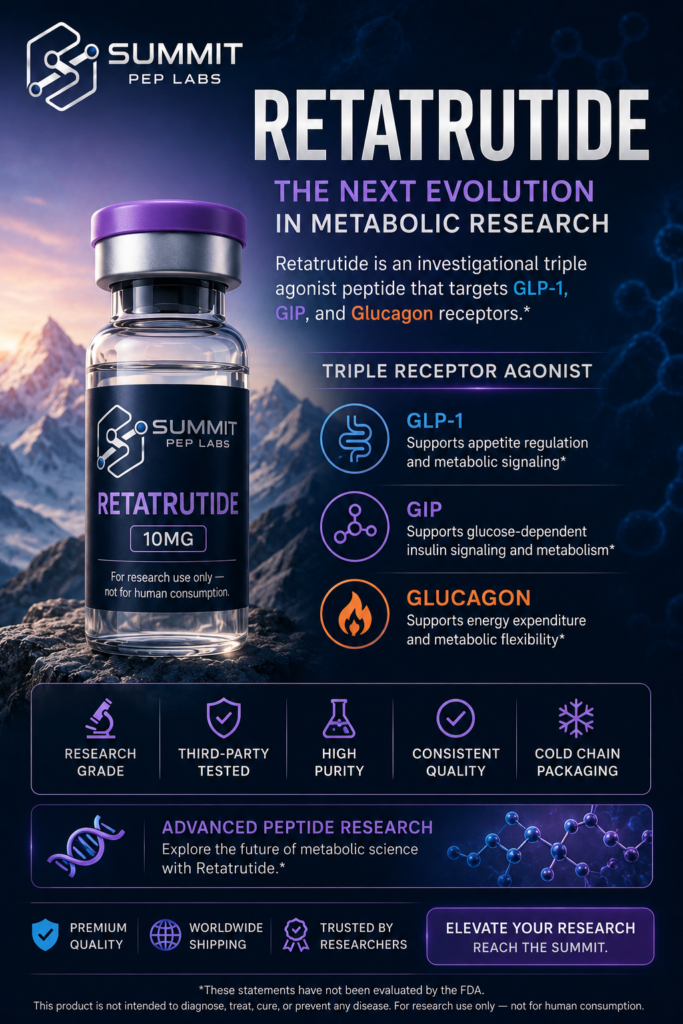
Retatrutide is one of the most widely discussed investigational peptides in modern metabolic research. Developed as a triple receptor agonist, it is designed to interact with three distinct signaling pathways involved in energy balance and metabolic regulation:
- 🧬 GLP-1 (Glucagon-Like Peptide-1)
- ⚡ GIP (Glucose-Dependent Insulinotropic Polypeptide)
- 🔥 Glucagon
Unlike earlier incretin-based compounds that target one or two receptors, Retatrutide activates all three, making it a major focus of ongoing clinical investigation.
📊 Retatrutide at a Glance
| Feature | Details |
|---|---|
| Compound Type | Triple receptor agonist |
| Primary Targets | GLP-1, GIP, Glucagon |
| Research Status | Investigational |
| Main Areas of Study | Metabolism, body composition, energy regulation |
| Clinical Development | Ongoing |
🧪 Why Are Retatrutide Clinical Trials Important?
Clinical trials are designed to evaluate how investigational compounds behave under carefully controlled research conditions.
Researchers studying Retatrutide continue investigating its effects on:
- ⚡ Energy metabolism
- 🧬 Incretin signaling
- 📈 Body composition
- 🍽️ Appetite regulation pathways
- 🔄 Metabolic flexibility
- ❤️ Cardiometabolic health
Because Retatrutide activates three receptors simultaneously, it represents an important step in the evolution of incretin-based research.
🔬 Understanding the Three Receptor Targets
One of the defining characteristics of Retatrutide is its ability to interact with multiple biological pathways.
🟢 GLP-1 Receptor
Researchers investigate GLP-1 signaling for its role in:
- Appetite regulation
- Gastric emptying
- Glucose-dependent metabolic pathways
🔵 GIP Receptor
GIP continues to be studied for its involvement in:
- Insulin signaling
- Energy balance
- Nutrient metabolism
🟠 Glucagon Receptor
The addition of glucagon receptor activity has generated significant interest in studies involving:
- Energy expenditure
- Fat metabolism
- Metabolic flexibility
📈 Current Areas of Investigation
Modern Retatrutide clinical trials continue exploring several key research questions.
Scientists are evaluating:
- Long-term metabolic adaptations
- Triple agonist receptor biology
- Energy utilization
- Hormonal signaling
- Changes in body composition
- Cardiometabolic biomarkers
These studies aim to better understand how simultaneous receptor activation influences complex metabolic systems.
🧬 How Retatrutide Differs From Earlier GLP-1 Research
| Compound | Receptors Targeted | Research Focus |
|---|---|---|
| Semaglutide | GLP-1 | Appetite and metabolic signaling |
| Tirzepatide | GLP-1 + GIP | Dual incretin biology |
| Retatrutide | GLP-1 + GIP + Glucagon | Triple agonist metabolic research |
This expanded receptor activity is one of the primary reasons Retatrutide has attracted considerable scientific attention.
🌎 Why Researchers Continue Following Retatrutide
Interest in Retatrutide continues to grow because it represents a newer generation of peptide research.
Scientists remain interested in its potential to provide insight into:
- Advanced metabolic signaling
- Multi-receptor pharmacology
- Endocrine physiology
- Cellular energy regulation
- Obesity-related research models
- Healthy aging investigations
📚 What Happens During Clinical Trials?
Clinical development generally progresses through several stages.
| Phase | Primary Objective |
|---|---|
| Phase 1 | Safety and pharmacokinetics |
| Phase 2 | Dose exploration and biological activity |
| Phase 3 | Large-scale evaluation across broader populations |
Each phase provides researchers with additional information about how an investigational compound behaves under controlled study conditions.
🔍 Frequently Asked Questions
What are Retatrutide clinical trials studying?
Current clinical trials continue exploring Retatrutide’s role in metabolism, body composition, energy regulation, and multi-receptor signaling through activation of GLP-1, GIP, and glucagon receptors.
Is Retatrutide approved?
Retatrutide remains an investigational compound. Researchers continue studying it through ongoing clinical development.
Why is Retatrutide different from Semaglutide?
Semaglutide primarily targets the GLP-1 receptor, while Retatrutide is designed to activate GLP-1, GIP, and glucagon receptors simultaneously.
Why has Retatrutide generated so much interest?
Its triple agonist mechanism makes it one of the most advanced investigational peptides currently being studied for metabolic research.
Is research-grade Retatrutide intended for human use?
No. Research-grade Retatrutide is intended for laboratory research only and is not approved for human consumption.
🏁 Final Thoughts
Retatrutide clinical trials continue to shape our understanding of triple agonist peptide biology and represent one of the most active areas of metabolic research today. By targeting GLP-1, GIP, and glucagon receptors, Retatrutide offers researchers a unique opportunity to investigate how multiple signaling pathways work together in regulating metabolism and energy balance.
As scientific interest in obesity research, metabolic health, and endocrine physiology continues to expand, Retatrutide remains at the forefront of next-generation peptide research.
10mg Retatrutide Product Page
20mg Retatrutide Product Page
60mg Retatrutide Product Page
Retatrutide Research 1
Retatrutide Research 2
Retatrutide Research 3