🧬 From Discovery to Laboratory Research: How Scientists Develop New Peptides
🔬 From Nature to the Laboratory: How Scientists Develop New Peptides
Every year, researchers discover new molecules that may help unlock a better understanding of biology. Among the most exciting are peptides—short chains of amino acids that act as the body’s natural messengers. They help regulate processes ranging from wound healing and metabolism to immune function and cellular communication.
But have you ever wondered how a peptide goes from an idea in a research laboratory to a highly purified vial used in scientific studies?
The journey is surprisingly complex. It combines biology, chemistry, computer modeling, advanced manufacturing, and rigorous quality testing before a peptide is ever studied in the laboratory.
In this article, we’ll explore the fascinating process scientists use to discover, design, synthesize, and evaluate modern research peptides.
⚠️ Research Use Only: All products offered by Summit Pep Labs are intended exclusively for laboratory research and are not approved for human consumption or therapeutic use.
🌿 Step 1: Discovery Begins in Nature
Many peptides don’t begin in a laboratory—they begin in nature.
Scientists have discovered biologically active peptides in:
- 🧬 Human cells
- 🐍 Snake venom
- 🐸 Amphibian skin secretions
- 🦠 Bacteria
- 🌊 Marine organisms
- 🌱 Plants
Nature has spent millions of years refining these molecules through evolution.
Researchers often identify a naturally occurring peptide that appears to play an important biological role. Once identified, they begin studying exactly how it works.
Examples include peptides involved in:
- Hormone signaling
- Immune responses
- Tissue repair
- Cell growth
- Metabolism
- Neurotransmission
Sometimes the naturally occurring peptide itself becomes the focus of research. In other cases, scientists use it as the blueprint for creating an improved laboratory version.
💻 Step 2: Designing Better Peptides
Modern peptide research relies heavily on computational biology.
Rather than creating random molecules and hoping one works, scientists use sophisticated software to predict how changes to a peptide’s amino acid sequence may influence its properties.
Researchers can model:
- 🧪 Three-dimensional structure
- 🔗 Receptor binding
- ⚡ Molecular stability
- 💧 Solubility
- 🧬 Folding behavior
- ⏳ Resistance to enzymatic breakdown
Today, artificial intelligence and molecular simulation software allow researchers to evaluate thousands—or even millions—of theoretical peptide designs before synthesizing a single one.
This dramatically speeds up discovery while reducing laboratory costs.
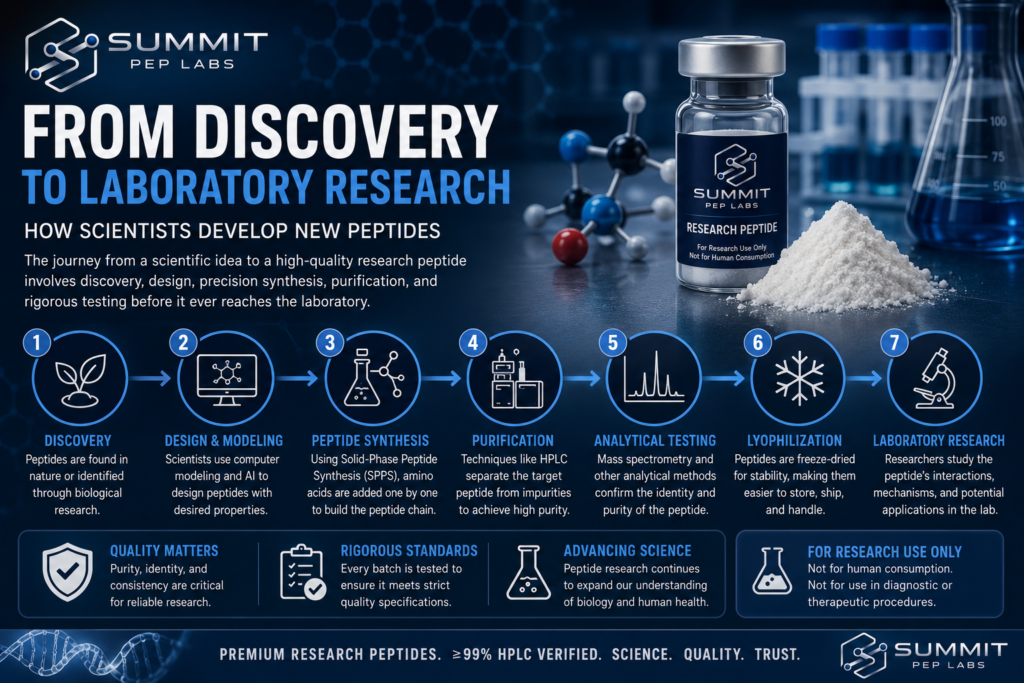
🧬 Step 3: Building the Peptide One Amino Acid at a Time
Once researchers settle on a sequence, the peptide must be manufactured.
Unlike proteins, which are produced naturally inside living cells, research peptides are commonly created using Solid-Phase Peptide Synthesis (SPPS).
Think of it like assembling a chain one link at a time.
The process generally follows these steps:
| Step | What Happens |
|---|---|
| 🧪 1 | The first amino acid is attached to a solid resin bead. |
| ➕ 2 | Protective groups are removed so another amino acid can be added. |
| 🔗 3 | The next amino acid is chemically bonded to the chain. |
| 🔄 4 | The cycle repeats until the complete peptide sequence is assembled. |
| ✂️ 5 | The finished peptide is separated from the resin and purified. |
Some research peptides contain only 5–10 amino acids, while others may contain 30 or more, requiring dozens of carefully controlled synthesis cycles.
Each additional amino acid increases manufacturing complexity, making precision essential.
🧪 Step 4: Purification Matters
After synthesis, the peptide is far from ready for research.
The manufacturing process naturally produces small amounts of incomplete sequences and byproducts that must be removed.
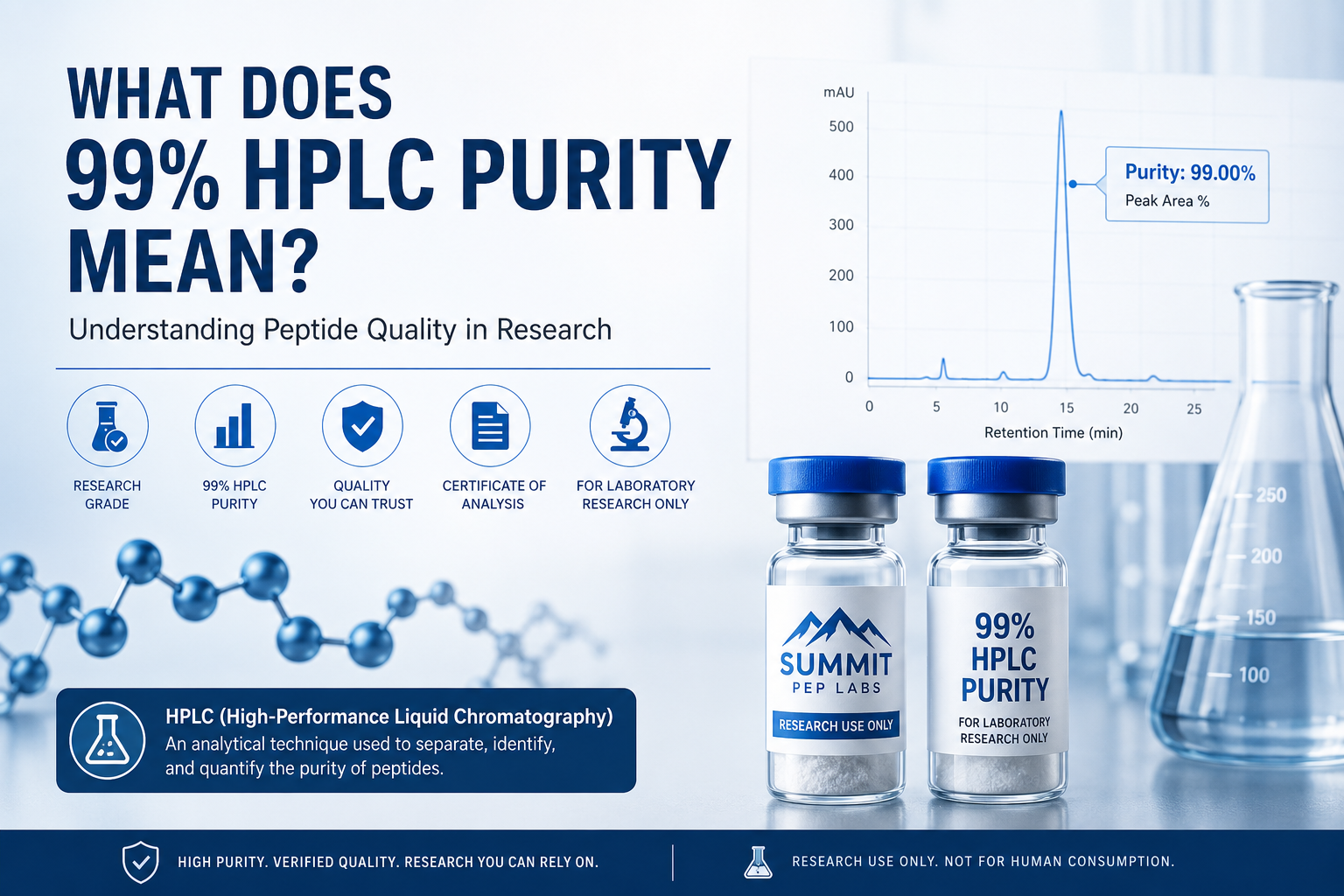
One of the most important tools scientists use is High-Performance Liquid Chromatography (HPLC).
HPLC separates molecules based on their chemical properties, allowing researchers to isolate the desired peptide from impurities.
Many research suppliers specify purity levels such as:
- ✅ 95%+
- ✅ 98%+
- ✅ 99%+
Higher purity allows researchers to better understand the effects of the peptide being studied while minimizing interference from contaminants.
What Does 99% HPLC Purity Mean?
🔍 Step 5: Verifying the Molecule
Purification alone isn’t enough.
Scientists must confirm that the molecule produced is actually the peptide they intended to create.
One common analytical technique is mass spectrometry.
Mass spectrometry measures the molecular weight of a compound with remarkable precision.
Researchers compare the measured molecular weight with the expected value to confirm that the peptide has been synthesized correctly.
Additional analytical methods may include:
- Nuclear Magnetic Resonance (NMR)
- Amino acid analysis
- UV spectroscopy
- Chromatographic fingerprinting
Together, these methods provide confidence in the identity and quality of the research material.
❄️ Step 6: Why Most Research Peptides Are Freeze-Dried
If you’ve ever purchased a research peptide, you’ve probably noticed that it arrives as a white powder rather than a liquid.
This process is called lyophilization, or freeze-drying.
During lyophilization:
- The peptide solution is frozen.
- Pressure is reduced in a vacuum chamber.
- Ice is removed through sublimation, changing directly from solid to vapor.
The result is a stable dry powder that is generally easier to transport and store than a liquid solution.
Researchers value lyophilized peptides because they are less susceptible to hydrolysis and other degradation pathways during storage.
Peptide Storage and Handling Guide
🔬 Step 7: Laboratory Evaluation Begins
Only after synthesis, purification, and quality verification does laboratory research begin.
Scientists may investigate how a peptide interacts with cells, tissues, enzymes, or receptors using carefully controlled experiments.
Common areas of peptide research include:
| Research Area | What Scientists Study |
|---|---|
| 🧬 Cell signaling | How peptides communicate between cells |
| ⚡ Metabolism | Energy regulation and nutrient sensing |
| 🧠 Neuroscience | Brain signaling pathways |
| 🛡️ Immunology | Immune system interactions |
| 🩹 Tissue biology | Cellular repair and regeneration |
| 🧪 Receptor pharmacology | Binding affinity and biological activity |
Many promising peptides never advance beyond this stage. That is a normal part of scientific research, where hypotheses are continually tested and refined.
🚀 Modern Peptide Research Is Advancing Faster Than Ever
Advances in technology have dramatically accelerated peptide discovery.
Researchers now combine:
- 🤖 Artificial intelligence
- 🧬 Genomic sequencing
- 💻 Molecular dynamics simulations
- 🔬 High-throughput screening
- 🧪 Automated peptide synthesizers
These tools enable scientists to evaluate thousands of candidate molecules far more efficiently than was possible just a decade ago.
As our understanding of cellular communication grows, peptide science continues to expand into new areas of research.
🧩 Why Quality Matters
Two vials labeled with the same peptide name are not necessarily equivalent.
Researchers evaluate several quality factors before selecting materials for laboratory studies, including:
- Purity
- Identity verification
- Manufacturing consistency
- Analytical documentation
- Proper storage and handling
These factors help improve reproducibility and confidence in research outcomes.
🌟 Examples of Peptides Under Active Investigation
Scientists continue to study a wide variety of peptides across different fields of research.
Examples include:
- 🧬 BPC-157 – investigated for tissue biology and cellular signaling.
- ⚡ MOTS-C – studied for mitochondrial function and metabolic pathways.
- 🔥 Retatrutide – researched for its activity at GLP-1, GIP, and glucagon receptors.
- 🧠 Semax – investigated for neurobiology and peptide signaling.
- 🧪 GHK-Cu – explored in studies of skin biology and extracellular matrix signaling.
Each peptide is examined within specific experimental models to better understand its biological mechanisms.
🔮 The Future of Peptide Science
The field of peptide research is evolving rapidly. As computational modeling, structural biology, and automated synthesis continue to improve, scientists are able to investigate increasingly sophisticated molecules designed to interact with highly specific biological targets.
Researchers are also exploring ways to improve peptide stability, receptor selectivity, and delivery methods, opening new avenues for laboratory investigation.
Although every promising peptide must undergo extensive research before its biological properties are fully understood, advances in peptide science continue to deepen our understanding of how cells communicate and respond to their environment.
❓ Frequently Asked Questions
What is a peptide?
A peptide is a short chain of amino acids linked together by peptide bonds. Peptides naturally occur throughout the body and participate in numerous biological signaling pathways.
How are research peptides made?
Most research peptides are produced using Solid-Phase Peptide Synthesis (SPPS), a method that assembles amino acids in a precise sequence before purification and analytical testing.
Why are peptides freeze-dried?
Lyophilization removes water while helping preserve peptide stability during storage and transportation.
What does HPLC purity mean?
HPLC purity indicates the proportion of the desired peptide in a sample after separation from impurities using High-Performance Liquid Chromatography.
Why is quality testing important?
Analytical testing helps verify that a peptide matches its intended molecular structure and meets purity standards before it is used in laboratory research.
📚 Continue Exploring
Interested in learning more? You may also enjoy:
- 🧪 What Does 99% HPLC Purity Mean?
- ❄️ Peptide Storage and Handling Guide
- 🧬 GLP-1 vs. GIP vs. Glucagon: Understanding Metabolic Signaling
- ⚡ Mitochondria and Cellular Energy: Why MOTS-C Is Being Studied
- 🔥 Retatrutide vs. Cagrilintide: Comparing Two Investigational Peptides
🏁 Final Thoughts
Every research peptide begins as a scientific question. From discoveries in nature to computer-assisted design, precision synthesis, purification, and analytical verification, each stage reflects the careful work required to produce high-quality materials for laboratory investigation.
Understanding this process not only highlights the complexity of peptide science but also underscores why quality, consistency, and rigorous analytical testing are so important. As technology continues to evolve, peptide research remains one of the most dynamic areas of modern biomedical science, offering researchers new tools to explore the intricate signaling networks that govern cellular function.