🚨 FDA Advisors Recommend Compounding Access for Several High-Profile Peptides
FDA peptide compounding update the peptide industry may be entering a new chapter.
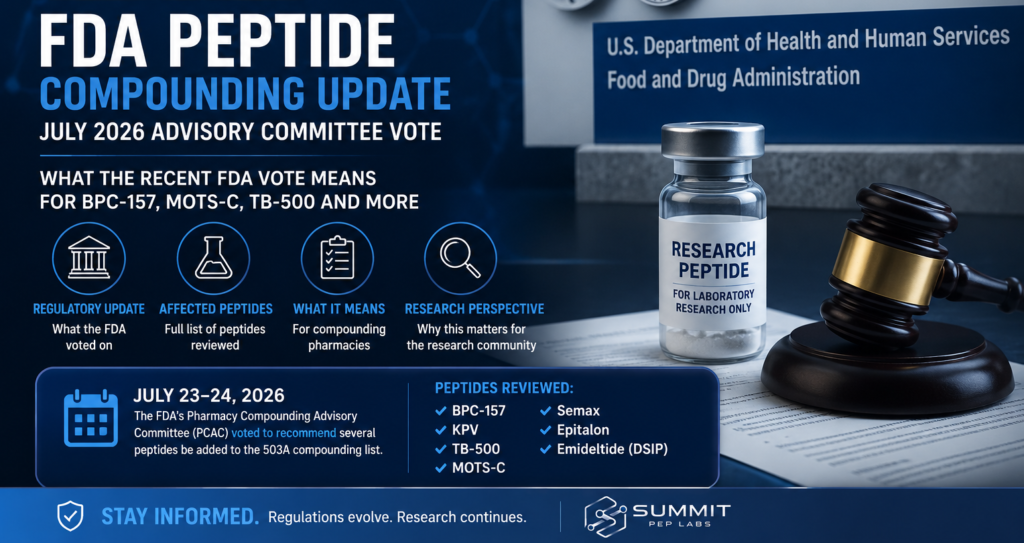
In July 2026, an FDA advisory committee voted in favor of recommending that several widely discussed peptides—including BPC-157, MOTS-C, TB-500, and KPV—be considered for inclusion on the 503A compounding bulks list. If ultimately adopted by the FDA, this could allow qualifying compounding pharmacies to legally compound these substances under federal compounding regulations.
The decision has generated enormous interest among researchers, clinicians, compounding pharmacies, and the broader peptide community.
However, there is one important detail:
The FDA has not issued a final approval decision.
The committee vote is advisory and does not automatically change the legal status of any peptide. Final authority remains with the FDA.
🧬 Which Peptides Received Support?
According to reports from the advisory meeting, committee members voted in favor of allowing compounding consideration for:
| Peptide | Advisory Outcome |
|---|---|
| 🧬 BPC-157 | Recommended for compounding consideration |
| 🧬 MOTS-C | Recommended for compounding consideration |
| 🧬 TB-500 | Recommended for compounding consideration |
| 🧬 KPV | Recommended for compounding consideration |
The committee also reviewed additional peptides including Semax, Epitalon, and DSIP during the two-day meeting.
⚖️ Does This Mean These Peptides Are FDA Approved?
No.
This is one of the biggest misconceptions surrounding the announcement.
A recommendation for inclusion on the 503A bulks list is not the same as FDA approval.
FDA-approved drugs must undergo extensive clinical testing demonstrating safety and effectiveness. Inclusion on a compounding list is an entirely different regulatory pathway.
In short:
| FDA Approval | 503A Compounding |
|---|---|
| Requires formal drug approval | Allows compounding under specific rules |
| Extensive clinical trials required | Separate compounding framework |
| Commercial pharmaceutical product | Customized compounded preparation |
| Full FDA approval | Not equivalent to approval |
🔬 Why Is This Such A Big Deal?
BPC-157, MOTS-C, TB-500, and KPV have become some of the most discussed peptides in research and wellness circles.
Researchers have shown interest in these compounds for areas including:
- Cellular signaling
- Metabolic pathways
- Recovery and tissue biology
- Mitochondrial function
- Inflammatory pathways
- Exercise physiology
The advisory committee’s recommendation reflects growing debate about how these substances should be regulated.
📈 Why Everyone Is Watching The FDA
The peptide market has expanded rapidly in recent years.
Industry observers believe a final FDA decision could significantly influence:
- Compounding pharmacies
- Telehealth providers
- Peptide manufacturers
- Researchers
- Physicians
- Patients seeking compounded therapies
Because of this potential impact, the advisory meeting received substantial attention across the healthcare and biotechnology industries.
Here is how a final FDA determination ripples across each stakeholder group:
🏥 1. Compounding Pharmacies (503A & 503B)
- Revenue streams vs. compliance risk: When the FDA restricted these peptides to Category 2 in late 2023, 503A compounding pharmacies lost major high-margin product lines. OpenLoop Health
- Operational green light: Inclusion on the 503A bulk list allows compounding pharmacies to legally mix and dispense tailored formulations with a valid prescription under state board oversight. Conversely, keeping them restricted forces pharmacies to enforce strict quality audits and avoid these active pharmaceutical ingredients (APIs) entirely. OpenLoop Health
💻 2. Telehealth Providers
- Business model evolution: Direct-to-consumer health platforms (like Hims & Hers, Noom, and specialized longevity clinics) rely heavily on prescribing compounded wellness and anti-aging therapies.
- Access & marketing scale: A favorable FDA ruling allows telehealth platforms to expand their treatment catalogs and aggressively market peptide protocols for recovery, gut health, and longevity. Restrictive rulings force them to limit offerings or rely strictly on standard, fully FDA-approved drugs. Lifetime Surgical
🧪 3. Peptide Manufacturers & Supply Chains
- Active Pharmaceutical Ingredient (API) standards: Legitimate compounding relies on bulk raw materials. A clear FDA path gives raw material manufacturers a legal framework to produce pharmaceutical-grade, cGMP-compliant peptides with validated Certificates of Analysis (COAs). OpenLoop Health
- Gray market displacement: Stricter rules historically drove consumers to unregulated online vendors (“research use only” suppliers). Regulatory clarity redirects volume back toward registered domestic manufacturers. CBS News
🔬 4. Researchers
- Clinical trial momentum: Many popular peptides have minimal human safety or efficacy trial data (often limited to animal studies). CBS News
- Establishing protocols: If the FDA requires ongoing data collection or formal clinical pathways to maintain compounding access, it will incentivize structured research into dosing, bioavailability, and long-term toxicity rather than relying solely on anecdotal claims.
🩺 5. Physicians & Healthcare Providers
- Liability and prescribing boundaries: Doctors offering integrative, anti-aging, or sports medicine have faced legal and regulatory grey areas when prescribing Category 2 compounds.
- Guidance and standard of care: Clear FDA guidance gives clinicians defined medical-necessity criteria and standardized dosing guidelines, reducing off-label liability. OpenLoop Health
🧍 6. Patients Seeking Compounded Therapies
- Safety vs. Access: Patients seeking alternatives for injury recovery, autoimmune management, or anti-aging face a tradeoff. Permitting compounding ensures access to affordable, regulated medications made in sterile environments rather than relying on risky “gray market” foreign imports.
- Affordability: Compounded versions are typically significantly cheaper than fully approved brand-name biological drugs, making treatment far more financially accessible for out-of-pocket cash-pay patients.
⏳ What Happens Next?
The FDA will now review the advisory committee’s recommendations before making a final determination.
Historically, advisory committee recommendations can influence FDA decisions, but they are not binding. The agency may agree, disagree, or request additional evaluation.
Until the FDA issues a final ruling, the regulatory status of these peptides remains unchanged.
🧬 Research Interest Continues To Grow
Regardless of future regulatory outcomes, research interest in these peptides continues to expand.
Popular research compounds include:
- BPC-157
- MOTS-C
- TB-500
- KPV
- Retatrutide
- NAD+
- GHK-Cu
❓Frequently Asked Questions
Did the FDA approve BPC-157?
No. The FDA advisory committee recommended considering BPC-157 for compounding eligibility, but the FDA has not issued a final approval decision.
Is MOTS-C FDA approved?
No. MOTS-C is not FDA approved. It was among the peptides discussed by the advisory committee for potential compounding consideration.
What is the 503A bulks list?
The 503A bulks list identifies certain substances that may be used by qualifying compounding pharmacies under federal compounding regulations.
Does compounding mean FDA approval?
No. Compounding eligibility and FDA approval are separate regulatory pathways.