🧬 What Does 99% HPLC Purity Mean?
If you’ve researched laboratory peptides, you’ve likely seen claims such as “99% HPLC Purity” or “≥99% Purity.” But what do these numbers actually represent, and why are they important?
For researchers, peptide purity is one of the primary quality indicators because it reflects how much of the sample consists of the intended peptide versus impurities or byproducts from manufacturing.
Understanding HPLC purity helps researchers evaluate peptide quality and interpret laboratory documentation with greater confidence.
⚠️ Research Use Only: Summit Pep Labs supplies peptides exclusively for laboratory research. Products are not intended for human consumption, diagnosis, or therapeutic use.
🔬 What Is HPLC?
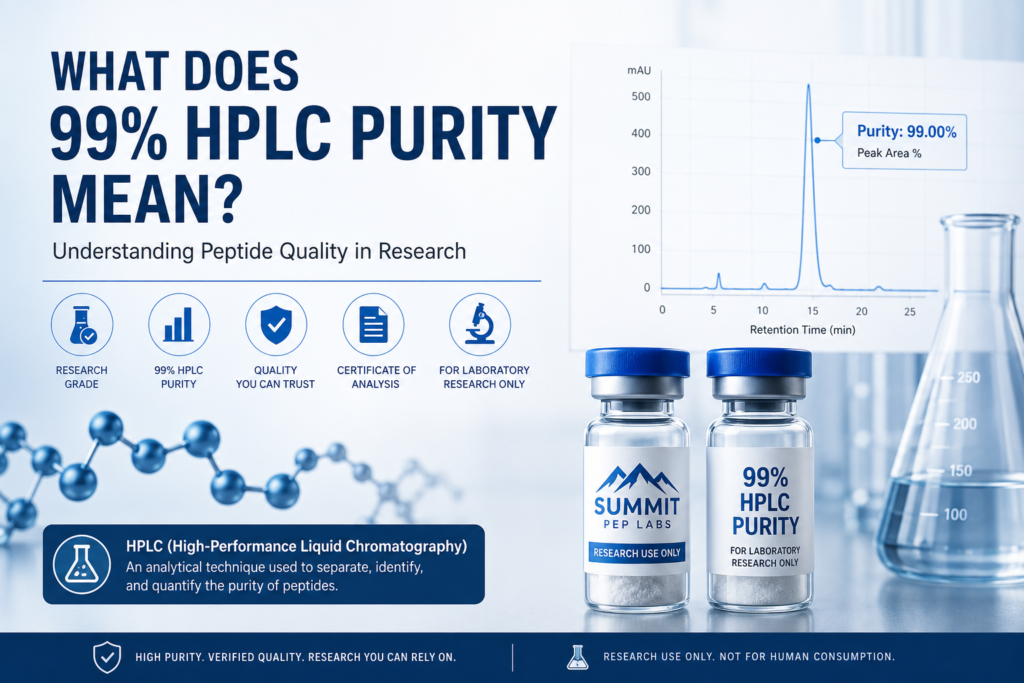
High-Performance Liquid Chromatography (HPLC) is an analytical technique used to separate, identify, and estimate the relative amounts of compounds in a sample.
Scientists commonly use HPLC to evaluate research peptides because it can distinguish the target peptide from closely related impurities.
HPLC helps researchers evaluate:
- 🧪 Sample purity
- 🧬 Manufacturing consistency
- 📊 Batch-to-batch quality
- 🔍 Presence of impurities
- 📈 Analytical performance
📊 What Does “99% Purity” Actually Mean?
When a peptide is reported as 99% HPLC pure, it generally means that approximately 99% of the detected chromatographic signal corresponds to the intended peptide, with the remaining signal representing impurities or related compounds under the testing conditions.
It does not necessarily mean every molecule in the vial is exactly 99% pure, nor does it describe sterility or biological activity.
| Purity Level | General Interpretation |
|---|---|
| ≥95% | Common for many research applications |
| ≥98% | High-purity research material |
| ≥99% | Very high analytical purity frequently sought for research |
⚙️ How Does HPLC Work?
A simplified overview:
- 🧪 A small sample is dissolved.
- 💧 The sample is passed through a chromatography column.
- ⏱️ Different compounds move through the column at different rates.
- 📈 A detector records peaks on a chromatogram.
- 📊 The peak areas are used to estimate the relative composition of the sample.
The desired peptide typically appears as the dominant peak if the sample is highly pure.
📈 Reading an HPLC Chromatogram
An HPLC chromatogram displays detector response over time.
| Feature | Meaning |
|---|---|
| 📍 Large peak | Primary peptide |
| 📍 Small peaks | Potential impurities or related compounds |
| 📍 Retention time | When a compound exits the column |
| 📍 Peak area | Used to estimate relative abundance |
Researchers compare chromatograms across batches to monitor manufacturing consistency.
🧬 Why Purity Matters
Higher analytical purity can help reduce variability in laboratory experiments by limiting interference from unwanted compounds.
Researchers often consider:
- ✅ Purity
- ✅ Identity
- ✅ Batch consistency
- ✅ Storage conditions
- ✅ Documentation
Purity is only one component of overall quality.
📄 What Is a Certificate of Analysis (COA)?
A Certificate of Analysis (COA) documents analytical testing performed on a production batch.
A COA may include:
| Test | Purpose |
|---|---|
| HPLC Purity | Estimates analytical purity |
| Mass Spectrometry | Confirms molecular weight |
| Appearance | Visual inspection |
| Batch Number | Product traceability |
| Testing Date | Quality documentation |
Reviewing a COA helps researchers verify that analytical testing has been performed for the specific batch.
❓ Is 99% Purity Always Necessary?
The appropriate purity depends on the research application.
For many laboratory studies, higher purity may reduce the likelihood that impurities influence experimental outcomes.
Rather than focusing on a single percentage, researchers often evaluate the complete quality profile, including analytical methods and supporting documentation.
📦 Storage Also Matters
Even a high-purity peptide should be stored appropriately to help preserve sample integrity.
Good laboratory practices include:
- ❄️ Following recommended storage conditions
- 🌑 Protecting samples from light when appropriate
- 💧 Limiting moisture exposure
- 🔒 Keeping containers sealed
- 📝 Maintaining accurate labels
Peptide Storage and Handling Guide.
🛒 Explore Research Peptides
At Summit Pep Labs, we provide research peptides manufactured for laboratory use.
Popular products include:
📚 Related Articles
Keep learning with these research guides:
- Peptide Storage and Handling Guide
- Retatrutide vs. Cagrilintide
- MOTS-C Research Guide
- NAD+ and Cellular Energy
- GHK-Cu Research Overview
Link each title to its corresponding article to strengthen your site’s internal linking.
❓ Frequently Asked Questions
What is HPLC?
High-Performance Liquid Chromatography is an analytical method used to separate compounds and evaluate the relative purity of a sample.
What does 99% HPLC purity mean?
It generally indicates that approximately 99% of the chromatographic signal corresponds to the target peptide under the testing conditions used.
Is HPLC the same as a Certificate of Analysis?
No. HPLC is a testing method, while a Certificate of Analysis is a document that summarizes the analytical results for a specific batch.
Does higher purity mean better research quality?
Higher purity is an important quality indicator, but researchers also consider identity testing, documentation, storage, and manufacturing consistency.
🌐 Additional Scientific Resources
For readers interested in analytical methods and peptide science:
- PubMed: https://pubmed.ncbi.nlm.nih.gov/
- National Center for Biotechnology Information (NCBI): https://www.ncbi.nlm.nih.gov/
- International Council for Harmonisation (ICH): https://www.ich.org/
- United States Pharmacopeia (USP): https://www.usp.org/
✅ Final Thoughts
HPLC purity is one of the most recognized analytical measures used to evaluate research peptides. Understanding what 99% HPLC purity represents—and what it does not—helps researchers interpret analytical results more effectively.
When assessing peptide quality, consider the complete picture: analytical purity, identity testing, documentation such as a Certificate of Analysis, proper storage, and reliable manufacturing practices. Taking all of these factors into account supports better-informed laboratory research and strengthens confidence in experimental materials.