🧬 What Are Peptide Receptors? Understanding the “Locks and Keys” of Cellular Communication
One of the most fascinating aspects of peptide research is that peptides rarely act alone. Their biological activity depends on their ability to interact with specialized proteins known as receptors.
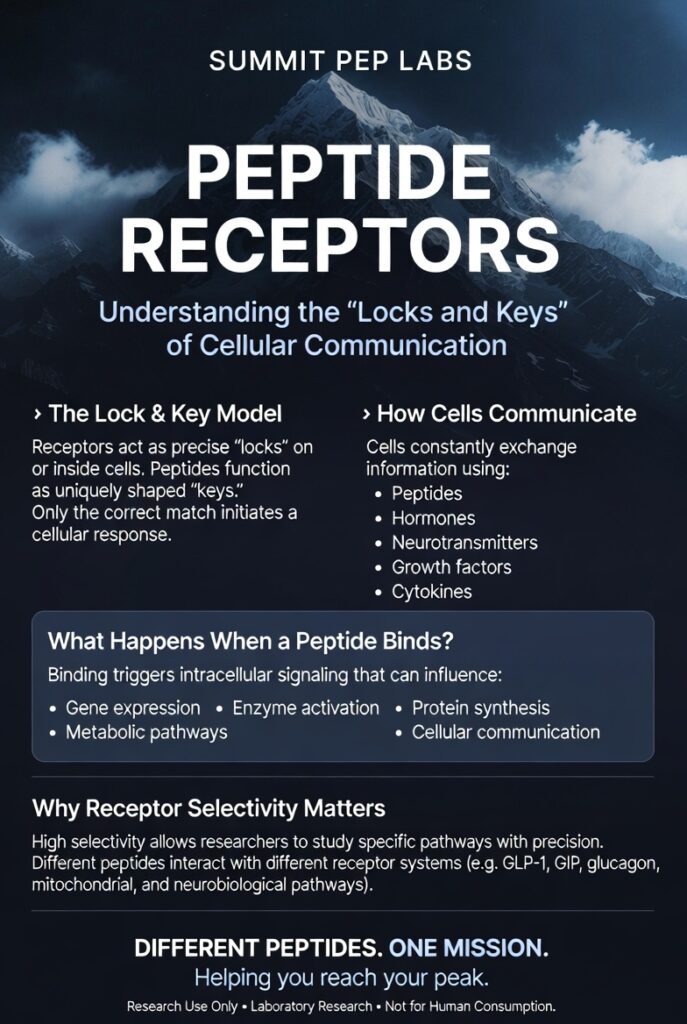
You can think of receptors as tiny locks located on the surface—or sometimes inside—cells. A peptide functions like a uniquely shaped key. When the right peptide encounters the right receptor, it can initiate a cascade of intracellular signals that influence how the cell behaves.
This remarkable communication system underlies countless physiological processes and is a central focus of modern biomedical research.
⚠️ Research Use Only: Products from Summit Pep Labs are intended exclusively for laboratory research and are not approved for human consumption or therapeutic use.
🔑 What Exactly Is a Receptor?
A receptor is a protein that recognizes specific signaling molecules and translates that interaction into a cellular response.
Researchers often describe this relationship using the lock-and-key model:
| 🔒 Receptor | 🔑 Peptide |
|---|---|
| Receives information | Delivers information |
| Recognizes specific molecules | Binds to matching receptors |
| Initiates cellular signaling | Starts the communication process |
Only the correct peptide can effectively bind to its corresponding receptor, allowing cells to respond with remarkable precision.
📡 How Cells Communicate
The human body contains trillions of cells, yet they work together seamlessly because they constantly exchange information.
Cells communicate using:
- 🧬 Peptides
- 🧪 Hormones
- ⚡ Neurotransmitters
- 🧫 Growth factors
- 🛡️ Cytokines
Each messenger carries instructions that help coordinate biological activity.
Researchers study these signaling pathways to better understand metabolism, tissue biology, neuroscience, immunology, and cellular physiology.
🧪 What Happens When a Peptide Binds?
Binding does not mean the peptide physically changes the cell—it means it initiates signaling.
A receptor may trigger:
- 📈 Gene expression changes
- ⚡ Enzyme activation
- 🔄 Protein synthesis
- 🧬 Cellular communication
- 📊 Metabolic signaling
- 🧫 Growth regulation
Rather than acting as simple “on/off” switches, many receptors fine-tune cellular responses depending on context.
🎯 Why Receptor Selectivity Matters
One reason peptide research is so exciting is that many peptides exhibit a high degree of receptor selectivity.
That means a peptide may preferentially interact with one receptor type while having little or no activity at others.
Researchers investigate selectivity because it helps clarify how specific signaling pathways contribute to different biological processes.
🔬 Examples of Receptor Targets
Different investigational peptides are studied because they interact with different biological systems.
| Peptide | Research Focus |
|---|---|
| 🧬 Retatrutide | GLP-1, GIP, and glucagon receptor pathways |
| ⚡ MOTS-C | Mitochondrial signaling and metabolic biology |
| 🩹 BPC-157 | Cellular signaling involved in tissue biology |
| 🧪 GHK-Cu | Extracellular matrix and skin biology research |
| 🧠 Semax | Neurobiological signaling pathways |
🤖 The Future of Receptor Research
Advances in cryo-electron microscopy, molecular modeling, and artificial intelligence are giving scientists unprecedented views of receptor structures.
Researchers can now simulate how peptides fit into receptors before synthesizing them, accelerating discovery and reducing development time.
This combination of structural biology and computational chemistry is reshaping peptide science.
📚 Related Reading
Strengthen your understanding by exploring:
- How Scientists Develop New Peptides
- GLP-1 vs. GIP vs. Glucagon
- Retatrutide vs. Cagrilintide
- What Does 99% HPLC Purity Mean?
- Peptide Storage & Handling Guide
❓ Frequently Asked Questions
What is a peptide receptor?
A peptide receptor is a protein that recognizes specific peptide molecules and initiates cellular signaling when binding occurs.
Why are receptors important?
Receptors allow cells to receive and respond to biological signals, coordinating processes such as metabolism, immune function, and cellular communication.
Do all peptides bind the same receptor?
No. Most peptides are studied for their interactions with specific receptor types or signaling pathways.
Why is receptor selectivity important?
Selective interactions help researchers understand how individual pathways contribute to normal cellular function and biological regulation.
🏁 Final Thoughts
Peptide receptors are fundamental to how cells communicate. By studying these highly specific interactions, researchers gain valuable insights into the signaling networks that regulate physiology at the cellular level.
Whether exploring metabolic pathways, tissue biology, or neuroscience, receptor science provides the foundation for understanding how investigational peptides function in laboratory research.