If you’ve spent any time researching peptides, you’ve probably noticed something that confuses many beginners:
Some products are labeled 10 mg, 20 mg, or 50 mg, while others—particularly hormones such as insulin or growth hormone—are measured in International Units (IU).
This raises a common question:
Why are research peptides measured in milligrams instead of IU?
The answer comes down to a fundamental difference between mass and biological activity.
Understanding that distinction can help researchers interpret product labels more accurately and prepare laboratory materials correctly.
Research Use Only: Products offered by Summit Pep Labs are intended exclusively for laboratory research and are not approved for human consumption or therapeutic use.
⚖️ Milligrams Measure Weight
A milligram (mg) is simply a unit of mass.
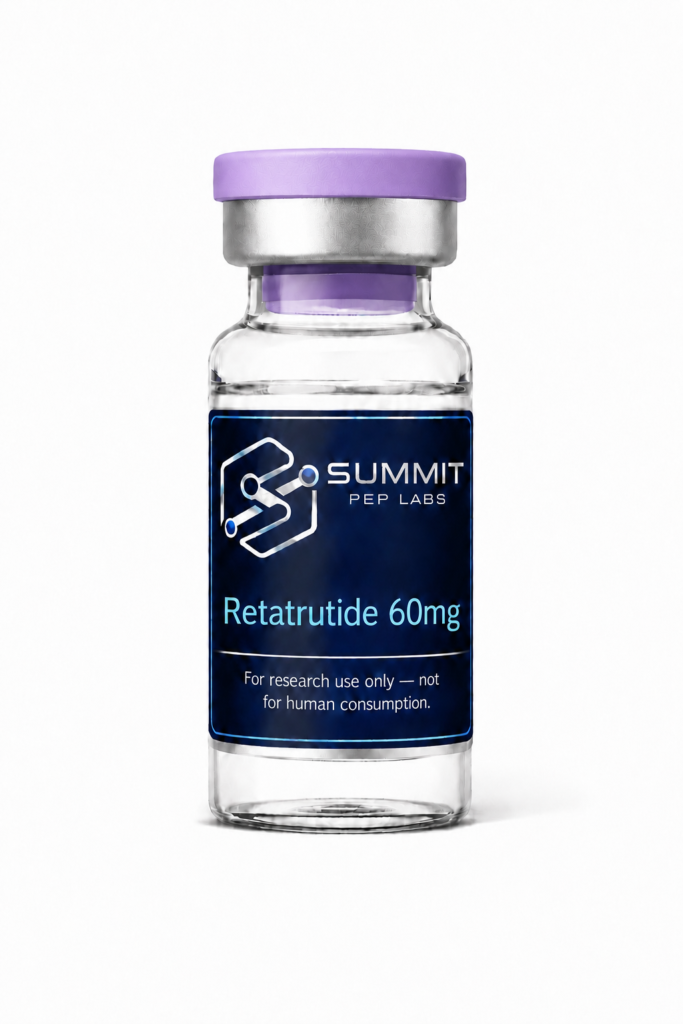
When a vial is labeled:
the label indicates how much peptide by weight is present before reconstitution.
Milligrams remain constant regardless of how much solvent is added later.
🌎 What Is an International Unit (IU)?
Unlike milligrams, an International Unit (IU) is not a measurement of weight.
Instead, IU is a standardized measurement of biological activity established for certain substances whose effects cannot be compared by weight alone.
Examples include:
- Insulin
- Vitamin D
- Vitamin E
- Human Growth Hormone (in many clinical contexts)
Two substances can weigh exactly the same but have different biological activities, which is why IU exists.
🔬 Why Most Research Peptides Use Milligrams
Research peptides are generally identified by their chemical composition.
Scientists need to know exactly how much peptide is present by mass because laboratory protocols are based on concentration calculations.
For that reason, peptide manufacturers almost always label products in milligrams rather than IU.
💧 What Happens After Reconstitution?
Once a peptide is reconstituted with bacteriostatic water or another laboratory solvent, the amount of peptide does not change.
Only the concentration changes.
For example:
| Peptide | Amount Added | Result |
|---|---|---|
| Retatrutide | 20 mg | Still contains 20 mg |
| Add 2 mL solvent | — | Concentration becomes 10 mg/mL |
| Add 4 mL solvent | — | Concentration becomes 5 mg/mL |
The vial still contains 20 mg total regardless of the volume added.
🧪 Why Concentration Matters
Researchers often calculate concentration to prepare consistent laboratory solutions.
Concentration depends on:
- Total peptide mass
- Volume of solvent
- Desired experimental protocol
Changing the amount of solvent changes the concentration—but not the total amount of peptide.
🧮 Why Peptide Calculators Are Helpful
Converting between:
- milligrams
- milliliters
- syringe markings
- concentration
can become confusing, especially for newcomers to peptide research.
That’s why many laboratories use peptide calculators to streamline these calculations and reduce errors.
📚 Common Misconceptions
| Myth | Reality |
|---|---|
| IU and mg are interchangeable | ❌ They measure different things. |
| Adding more water increases the peptide amount | ❌ Only concentration changes. |
| Every peptide has an IU conversion | ❌ Most research peptides do not. |
| A 20 mg vial becomes “40 mg” if diluted | ❌ The peptide mass remains the same. |