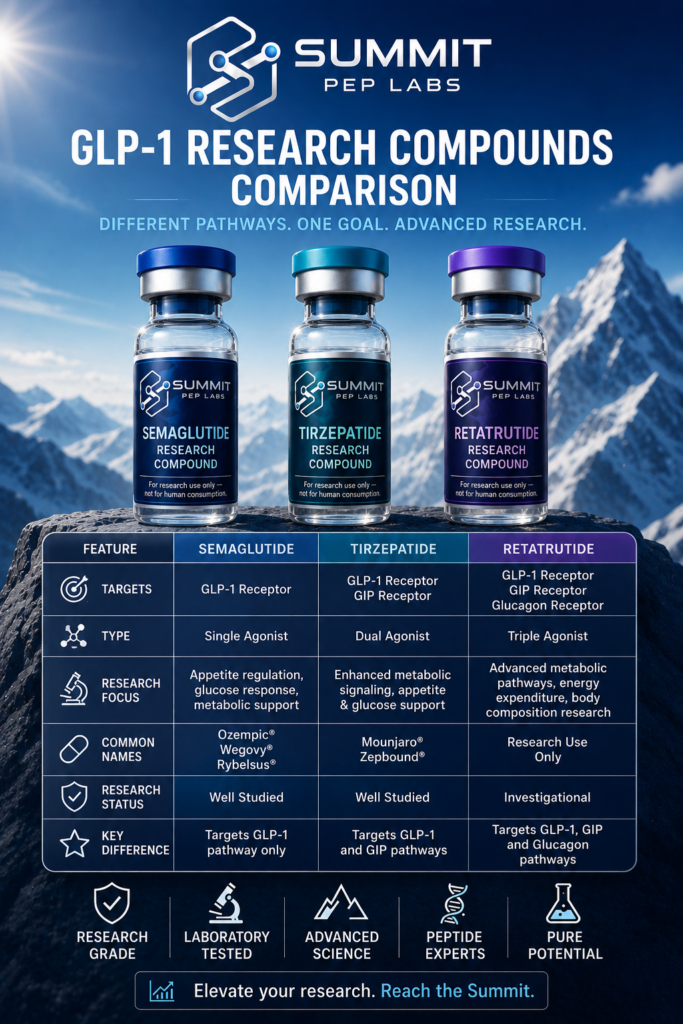
Understanding the Differences Between Modern GLP-1 Research Compounds
🔬 Retatrutide vs Tirzepatide vs Semaglutide
Understanding the Differences Between Modern GLP-1 Research Compounds
Research Use Only
Semaglutide, Tirzepatide, and Retatrutide are widely studied in laboratory settings for their interactions with incretin-related metabolic pathways. This guide is intended for educational and research purposes only.
🧬 Introduction
Over the past several years, GLP-1 research compounds have become some of the most widely discussed molecules in metabolic and longevity science.
While Semaglutide helped bring GLP-1 receptor research into the mainstream, newer compounds such as Tirzepatide and Retatrutide have expanded scientific interest by targeting multiple metabolic pathways simultaneously.
Researchers continue investigating these compounds because of their involvement in:
- ⚡ Energy metabolism
- 🍽️ Appetite signaling
- 🔄 Glucose-dependent pathways
- ⚖️ Body composition research
- 🧬 Metabolic flexibility
- 🔥 Energy expenditure
- 🧠 Hormonal signaling
Each generation of incretin-based compounds has introduced new receptor targets and increasingly complex mechanisms that continue to shape modern metabolic research.
📊 Quick Comparison
| Compound | Receptors Targeted | Generation | Primary Research Focus |
|---|---|---|---|
| Semaglutide | GLP-1 | First Generation | Appetite & metabolic signaling |
| Tirzepatide | GLP-1 + GIP | Second Generation | Dual incretin pathway research |
| Retatrutide | GLP-1 + GIP + Glucagon | Third Generation | Triple agonist metabolic research |
🧪 What Are GLP-1 Research Compounds?
GLP-1 (Glucagon-Like Peptide-1) receptor agonists are compounds studied for how they interact with hormones involved in metabolism and nutrient regulation.
Researchers commonly investigate GLP-1 signaling because it influences numerous physiological processes including:
- 🍽️ Appetite regulation
- 🩸 Glucose-dependent insulin signaling
- ⏳ Gastric emptying
- ⚡ Energy balance
- 🔄 Metabolic efficiency
- 🧬 Hormonal communication
As peptide research has evolved, scientists have developed compounds that activate additional receptor pathways beyond GLP-1 alone.
🟢 Semaglutide Overview
Semaglutide is one of the best-known GLP-1 receptor agonists and has served as the foundation for much of today’s incretin research.
Common Brand Names
- Ozempic®
- Wegovy®
- Rybelsus®
Primary Target
✅ GLP-1 receptor
Areas of Research
- Appetite signaling
- Metabolic regulation
- Energy intake
- Body composition
- Glucose-dependent pathways
Semaglutide’s extensive research history has made it one of the most recognizable compounds in metabolic science and helped establish widespread interest in GLP-1 biology.
🔵 Tirzepatide Overview
Tirzepatide represents the next generation of incretin research by activating two metabolic receptors simultaneously.
Common Brand Names
- Mounjaro®
- Zepbound®
Targets
✅ GLP-1 receptor
✅ GIP receptor
Researchers study Tirzepatide for its dual-pathway activity involving:
- Appetite regulation
- Metabolic signaling
- Body composition
- Glucose homeostasis
- Energy utilization
The addition of GIP receptor activity distinguishes Tirzepatide from earlier GLP-1-only compounds.
🟣 Retatrutide Overview
Retatrutide is among the newest investigational peptides in metabolic research and is often described as a triple receptor agonist.
Targets
✅ GLP-1 receptor
✅ GIP receptor
✅ Glucagon receptor
This third receptor significantly expands the biological pathways currently being investigated.
Researchers continue studying Retatrutide in relation to:
- 🔥 Energy expenditure
- ⚡ Metabolic flexibility
- 🧬 Nutrient partitioning
- ⚖️ Body composition
- 🍽️ Appetite signaling
- 🔄 Advanced metabolic regulation
Because it activates three receptor systems simultaneously, Retatrutide has generated considerable interest within metabolic and longevity research communities.
⚙️ Understanding the Three Receptors
| Receptor | Primary Area of Research |
|---|---|
| 🟢 GLP-1 | Appetite signaling, gastric emptying, glucose-dependent insulin secretion |
| 🔵 GIP | Nutrient metabolism and incretin signaling |
| 🔴 Glucagon | Energy expenditure, fuel utilization, metabolic flexibility |
Retatrutide is currently unique because it combines all three pathways into a single investigational molecule.
📈 Evolution of Incretin Research
| Generation | Compound | Number of Targets |
|---|---|---|
| 🥇 First | Semaglutide | 1 |
| 🥈 Second | Tirzepatide | 2 |
| 🥉 Third | Retatrutide | 3 |
This progression illustrates how researchers continue expanding beyond single-receptor approaches toward more comprehensive metabolic pathway investigations.
⚖️ Semaglutide vs Tirzepatide
Although both compounds activate the GLP-1 receptor, Tirzepatide introduces an additional GIP pathway.
Semaglutide
- ✅ Single receptor agonist
- ✅ Long-established research profile
- ✅ Extensive published literature
- ✅ Widely recognized in GLP-1 studies
Tirzepatide
- ✅ Dual receptor agonist
- ✅ Broader metabolic signaling
- ✅ Additional GIP activity
- ✅ Expanded incretin research focus
🚀 Tirzepatide vs Retatrutide
Retatrutide builds upon Tirzepatide’s dual-pathway framework by adding glucagon receptor activation.
Researchers continue exploring whether this third pathway may influence:
- ⚡ Energy expenditure
- 🔥 Fuel utilization
- 🔄 Metabolic flexibility
- 🧬 Physiological adaptation
- 📈 Overall metabolic signaling
Because of this expanded mechanism, Retatrutide is frequently referred to as the next evolution in incretin research.
📊 Side-by-Side Comparison
| Feature | Semaglutide | Tirzepatide | Retatrutide |
|---|---|---|---|
| GLP-1 | ✅ | ✅ | ✅ |
| GIP | ❌ | ✅ | ✅ |
| Glucagon | ❌ | ❌ | ✅ |
| Number of Targets | 1 | 2 | 3 |
| Research Status | Extensive | Extensive | Investigational |
| Primary Interest | Appetite pathways | Dual incretin biology | Triple agonist metabolism |
🌎 Why Retatrutide Is Receiving So Much Attention
Several factors continue driving scientific interest in Retatrutide research:
- 🧬 Triple receptor activation
- ⚡ Broader metabolic pathway engagement
- 🔥 Energy expenditure investigations
- 📈 Metabolic flexibility research
- ⚖️ Body composition studies
- ⏳ Longevity and healthy aging discussions
As additional research becomes available, Retatrutide remains one of the fastest-growing topics within peptide science.
📚 Why GLP-1 Research Continues to Expand
Modern metabolic research extends far beyond appetite alone.
Researchers continue exploring incretin-related compounds for their involvement in:
- Metabolic syndrome
- Obesity research
- Energy regulation
- Endocrine signaling
- Healthy aging
- Longevity science
- Mitochondrial metabolism
- Body composition
The evolution from Semaglutide to Tirzepatide and now Retatrutide reflects a broader scientific effort to better understand the complexity of metabolic regulation.
📋 Quick Summary Table
| Compound | Best Known For |
|---|---|
| 🟢 Semaglutide | GLP-1 receptor agonist and foundational incretin research |
| 🔵 Tirzepatide | Dual GLP-1/GIP receptor agonist |
| 🟣 Retatrutide | Triple GLP-1/GIP/Glucagon receptor agonist |
🏁 Final Thoughts
Semaglutide, Tirzepatide, and Retatrutide each represent important milestones in the evolution of incretin-based metabolic research.
Semaglutide introduced many researchers to GLP-1 biology, Tirzepatide expanded the field through dual receptor activation, and Retatrutide has further advanced scientific interest with its unique triple agonist mechanism.
As research into metabolism, longevity, energy regulation, and body composition continues to evolve, these compounds remain central to ongoing investigations into how multiple hormonal pathways work together to regulate complex physiological processes.
Disclaimer: This content is intended for educational and laboratory research purposes only. Research compounds are not approved for human consumption and are not intended to diagnose, treat, cure, or prevent any disease.