KLOW peptide blend has become an increasingly interesting subject in peptide research because it combines four compounds with distinctly different areas of biological investigation: BPC-157, TB-500, GHK-Cu, and KPV.
Rather than focusing on one signaling pathway, KLOW brings together compounds that researchers study in connection with tissue repair, extracellular matrix biology, cellular migration, angiogenic signaling, inflammation, and skin biology.
But understanding KLOW peptide blend requires looking beyond the marketing surrounding peptide blends.
What exactly does each component do?
How are the four peptides different?
Why might researchers be interested in studying them together?
And perhaps most importantly: what does the scientific literature actually tell us—and what remains unknown?
This comprehensive KLOW peptide research guide breaks down the individual components, their proposed mechanisms, the evidence supporting each peptide, and the limitations researchers should understand when evaluating a multi-peptide formulation.
⚠️ Research Disclaimer: KLOW peptide and its individual components discussed in this article are investigational research materials. This article is for educational and scientific research purposes only. It is not medical advice and does not recommend human or veterinary use. The KLOW peptide combination itself has not been established as an FDA-approved therapy or validated in controlled clinical trials.
🧪 What Is KLOW?
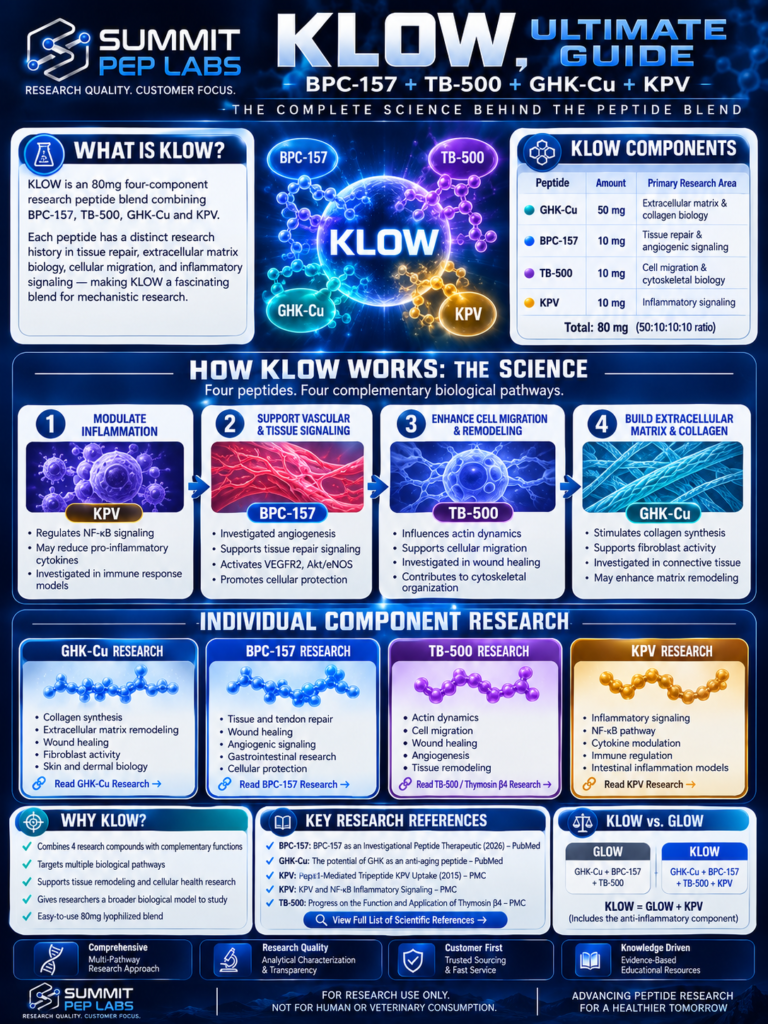
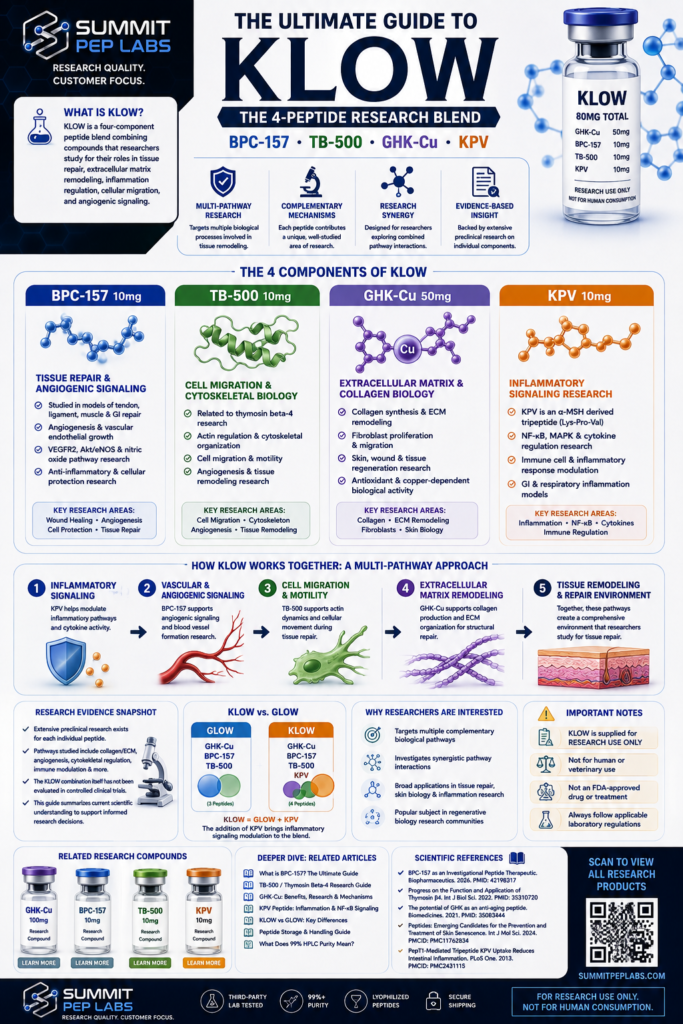
KLOW is a four-component peptide research blend containing:
| Component | Amount in KLOW | Primary Research Area |
|---|---|---|
| 🧬 GHK-Cu | 50 mg | Extracellular matrix & collagen biology |
| 🔬 BPC-157 | 10 mg | Tissue repair & angiogenic signaling |
| 🧫 TB-500 | 10 mg | Cell migration & cytoskeletal biology |
| 🧪 KPV | 10 mg | Inflammatory signaling |
The formulation sold by Summit Pep Labs contains 80 mg total peptide material in a fixed 50:10:10:10 ratio.
That composition is important because KLOW isn’t simply one peptide with four names.
It is a multi-component research formulation in which each compound has a different molecular structure and a different research history.
This creates an interesting scientific question:
🧩 Can multiple biological pathways involved in tissue remodeling and inflammatory regulation be investigated simultaneously?
That is one of the reasons multi-peptide formulations such as KLOW have attracted attention within research communities.
However, there is an important distinction between a mechanistic rationale and a demonstrated biological outcome.
The individual peptides have been studied separately, but the KLOW combination itself has not been established through a controlled clinical trial.
🔬 The Four Components of KLOW
The easiest way to understand KLOW is to examine each component independently.
Think of the blend as four different research “arms”:
                    🧬 KLOW
                       │
       ┌───────────────┼───────────────┐
       │               │               │
    GHK-Cu          BPC-157         TB-500
       │               │               │
   ECM / collagen   Repair /       Migration /
                   angiogenesis    cytoskeleton
                       │
                       │
                      KPV
                       │
                Inflammatory
                  signaling
Each component brings a different biological research question to the formulation.
🧬 1. GHK-Cu: The Extracellular Matrix Component
GHK-Cu is perhaps the most structurally distinctive component of KLOW.
GHK stands for:
Glycine-Histidine-Lysine
The tripeptide has a strong affinity for copper ions and forms the copper complex commonly known as GHK-Cu.
GHK-Cu has been investigated for decades, particularly in relation to:
- Collagen synthesis
- Extracellular matrix remodeling
- Fibroblast activity
- Wound biology
- Skin regeneration
- Angiogenesis
- Inflammatory signaling
- Copper-dependent biochemical processes
Research has demonstrated that GHK-Cu can influence collagen and extracellular-matrix production in experimental models.
For example, a classic study published in FEBS Letters reported stimulation of collagen synthesis in fibroblast cultures exposed to GHK-Cu.
Another experimental study found that GHK-Cu increased collagen and glycosaminoglycan accumulation in rat wound models.
More recent reviews continue to examine GHK-Cu’s potential involvement in tissue remodeling and skin biology.
🧬 Why does that matter for KLOW?
The extracellular matrix is essentially the structural environment surrounding cells.
It contains components such as:
- Collagen
- Elastin
- Glycosaminoglycans
- Proteoglycans
- Structural proteins
Researchers studying tissue repair are therefore interested in molecules that influence how this matrix is produced, remodeled, and organized.
This gives GHK-Cu a particularly interesting role within the theoretical architecture of KLOW.
Summit Pep Labs GHK-Cu research product is supplied as a lyophilized research compound and is listed for laboratory research applications involving extracellular matrix biology, peptide-copper interactions, and cellular signaling.
🔬 2. BPC-157: Tissue Repair & Angiogenic Research
BPC-157 is a synthetic pentadecapeptide that has received substantial attention in preclinical research.
Researchers have investigated BPC-157 in experimental models involving:
- Wound healing
- Tendons
- Ligaments
- Muscle
- Gastrointestinal tissues
- Angiogenesis
- Fibroblast activity
- Nitric oxide signaling
- Inflammatory pathways
A review published in Cell and Tissue Research examined BPC-157 in the context of musculoskeletal soft-tissue healing and highlighted extensive preclinical research while also noting that human efficacy had not been established.
More recent reviews continue to investigate proposed mechanisms involving pathways such as VEGFR2, Akt/eNOS, ERK1/2, angiogenesis, and fibroblast activity.
🩸 Angiogenesis
One particularly interesting research area is angiogenesis.
Angiogenesis refers to the formation of new blood vessels.
Researchers study angiogenesis because vascular supply is closely connected with tissue remodeling and repair.
Experimental BPC-157 research has investigated signaling involving VEGFR2 and nitric oxide pathways, among others.
That makes BPC-157 mechanistically different from GHK-Cu.
While GHK-Cu has a strong research history surrounding extracellular matrix and collagen biology, BPC-157 research frequently focuses on:
vascular signaling + tissue repair + cellular responses
⚠️ Evidence matters
This is one area where it is especially important to distinguish preclinical research from established clinical evidence.
A 2025 review concluded that BPC-157 has substantial preclinical literature but that human data remain extremely limited.
That distinction should remain front and center whenever BPC-157 is discussed.
Related articles: BPC-157 research .
.
🧫 3. TB-500: Cell Migration & Cytoskeletal Research
TB-500 is commonly discussed in connection with thymosin beta-4-related biology.
This distinction is important.
Thymosin beta-4 is a naturally occurring protein, while TB-500 refers to a synthetic peptide associated with a portion of thymosin beta-4 biology.
Thymosin beta-4 has been studied extensively in relation to:
- Actin regulation
- Cell migration
- Wound healing
- Angiogenesis
- Tissue remodeling
- Cytoskeletal organization
A review in Trends in Molecular Medicine described thymosin beta-4 as an actin-sequestering protein with important roles in tissue repair and wound healing research.
🧬 Why is actin important?
Actin is one of the fundamental structural proteins inside cells.
It contributes to:
- Cell shape
- Cell movement
- Cytoskeletal organization
- Intracellular transport
- Cellular migration
Cell migration is particularly important during tissue remodeling.
When researchers examine wound closure, for example, cells need to move into damaged areas.
Therefore, molecules affecting cytoskeletal organization and cellular migration are interesting subjects for regenerative biology research.
🧩 TB-500’s place in KLOW
This gives TB-500 a different mechanistic role from BPC-157 and GHK-Cu.
A simplified conceptual model would be:
GHK-Cu → extracellular matrix
BPC-157 → vascular/tissue signaling
TB-500 → cytoskeletal organization & migration
This is one reason researchers may find the combination conceptually interesting.
🧪 4. KPV: Inflammatory Signaling Research
KPV is the smallest component of KLOW.
It is a tripeptide consisting of:
Lysine-Proline-Valine
KPV corresponds to the C-terminal portion of alpha-melanocyte-stimulating hormone (α-MSH).
Research into α-MSH and related peptides has demonstrated extensive interest in inflammatory regulation.
Studies have examined pathways including:
- NF-κB
- Cytokine production
- Immune-cell activity
- MAPK signaling
- Inflammatory responses
A PubMed-indexed review specifically identified KPV as an α-MSH-derived tripeptide with potential anti-inflammatory properties in experimental models.
Research involving α-MSH has also demonstrated effects on NF-κB signaling, cytokine production, immune-cell migration, and other inflammatory pathways.
🔥 Why inflammatory signaling matters
Inflammation isn’t inherently harmful.
It is a normal biological response to:
- Injury
- Infection
- Cellular stress
- Tissue damage
The problem is that the timing, intensity, and duration of inflammatory signaling matter.
Consequently, researchers investigate compounds that can modulate inflammatory pathways rather than simply thinking about inflammation as something that should always be “turned off.”
KPV provides KLOW with a distinct research angle centered around inflammatory signaling regulation.
📊 KLOW peptide blend Components Compared
Here’s the simplest way to visualize the four components:
| Peptide | Main Research Focus | Major Research Themes |
|---|---|---|
| 🧬 GHK-Cu | ECM biology | Collagen, fibroblasts, matrix remodeling |
| 🔬 BPC-157 | Tissue repair | Angiogenesis, VEGFR2, Akt/eNOS |
| 🧫 TB-500 | Cell movement | Actin, cytoskeleton, migration |
| 🧪 KPV | Inflammatory signaling | NF-κB, cytokines, MAPK |
This doesn’t mean each compound performs only one function.
Biological signaling is considerably more complicated than that.
Each peptide can influence multiple pathways, and many of those pathways overlap.
🌐 Why Would Researchers Combine These Peptides?
This is where KLOW peptide blend becomes particularly interesting.
Instead of asking:
“What does KLOW do?”
A more scientifically appropriate question is:
“What biological processes are represented by the individual components of KLOW?”
Consider a simplified tissue-remodeling model.
🩸 Phase 1 — Inflammatory signaling
KPV research focuses on inflammatory pathways.
⬇️
🧬 Phase 2 — Vascular signaling
BPC-157 research frequently examines angiogenic and vascular signaling.
⬇️
🧫 Phase 3 — Cellular migration
TB-500/thymosin beta-4 research examines actin dynamics and cellular movement.
⬇️
🧱 Phase 4 — Matrix remodeling
GHK-Cu research investigates collagen and extracellular matrix biology.
This creates a biological rationale for investigating multiple pathways simultaneously.
But—and this is extremely important—the diagram represents a research hypothesis, not a proven clinical sequence.
There is currently no controlled clinical evidence demonstrating that KLOW peptide produces a particular outcome because these four compounds were combined.
🔬 KLOW peptide blend vs Individual Peptides
One of the biggest questions researchers may have is:
Why use a blend instead of studying each peptide independently?
There are legitimate scientific reasons to investigate both approaches.
Individual peptide research
Studying compounds separately allows researchers to determine:
- Which compound causes an observed effect
- Which pathway is involved
- Dose-response relationships
- Molecular interactions
- Specific cellular targets
Multi-component research
A blend can be useful for investigating:
- Pathway interactions
- Combined signaling
- Potential additive effects
- Multi-target biological models
- Interactions between inflammatory, vascular, cytoskeletal, and matrix pathways
However, combination research introduces additional variables.
If a result changes after adding a second compound, researchers must determine whether the interaction is:
Additive → effects simply combine
Synergistic → combined effect exceeds the individual effects
Antagonistic → one compound reduces the effect of another
That is precisely why controlled experimental design matters.
🧬 What Does the Research Actually Say About KLOW peptide blend?
This is probably the most important section of the entire article.
What we know:
There is substantial research on individual components, particularly GHK-Cu, thymosin beta-4-related biology, BPC-157, and α-MSH/KPV-related inflammatory signaling.
What we don’t know:
There is not an established body of controlled clinical evidence demonstrating that the KLOW combination itself produces a particular therapeutic outcome.
That means researchers should not take studies performed on one component and automatically assume that the same result applies to the complete blend.
For example:
A BPC-157 study ≠ a KLOW peptide study.
Similarly:
A GHK-Cu study ≠ a KLOW peptide study.
And:
A thymosin beta-4 study ≠ proof of TB-500/KLOW clinical efficacy.
This distinction is critical for interpreting peptide research responsibly.
🧪 Why Analytical Quality Matters in Peptide Research
When researchers study multi-component formulations, identity and analytical purity become particularly important.
If an experimental result changes, researchers need confidence that the material being studied actually contains what the label says it contains.
Important analytical considerations include:
🔬 HPLC
High-performance liquid chromatography can be used to evaluate chromatographic purity.
🧪 LC-MS
Liquid chromatography–mass spectrometry can help confirm molecular identity and molecular mass.
📄 Certificates of Analysis
A batch-specific COA can provide documentation regarding analytical testing.
🧬 Component verification
For a multi-peptide formulation, confirming the identity of each component is particularly important.
Summit Pep Labs states that its KLOW formulation is supplied as a co-lyophilized 80 mg blend containing 50 mg GHK-Cu, 10 mg BPC-157, 10 mg TB-500, and 10 mg KPV, with analytical testing described on the product page.
👉 Internal link opportunity: Link the phrase “What Does 99% HPLC Purity Mean?” to your existing HPLC article.
You can also link:
“Understanding Certificates of Analysis (COAs)”
to your COA educational article.
This is excellent for your broader research-quality content cluster.
🧊 KLOW peptide and Lyophilization
Another useful research consideration is the physical form of the material.
KLOW is supplied as a lyophilized, or freeze-dried, powder.
Lyophilization is commonly used with peptide materials because removing water can improve storage characteristics compared with maintaining the compound continuously in solution.
This creates another opportunity for internal linking.
👉 Internal link:
What Is Lyophilization? Understanding Freeze-Dried Peptides
👉 Internal link:
Peptide Storage & Handling Guide
Those articles can link back to this KLOW pillar page, creating a stronger topical cluster.
🧪 KLOW peptide Research: What Researchers Could Investigate
A KLOW research model could theoretically examine multiple biological endpoints.
For example:
| Research Area | Potential Experimental Endpoint |
|---|---|
| 🧬 ECM biology | Collagen deposition |
| 🩸 Angiogenesis | Endothelial-cell activity |
| 🧫 Cell migration | Scratch-wound assays |
| 🔥 Inflammation | Cytokine expression |
| 🧬 Fibroblast biology | Proliferation/migration |
| 🧪 Signaling | NF-κB / MAPK / Akt pathways |
| 🧱 Tissue remodeling | ECM marker expression |
The important word is investigate.
These are research endpoints—not promises about what the blend will accomplish in humans.
⚠️ KLOW peptide Safety & Regulatory Considerations
KLOW should not be confused with an FDA-approved medication.
The FDA has recently considered individual substances including BPC-157, KPV, and TB-500-related bulk drug substances in the context of the 503A Bulk Drug Substances List. However, an advisory committee discussion or recommendation is not equivalent to FDA approval of a drug for human use.
That distinction is especially important as peptide-related regulatory discussions continue.
For research materials, researchers should consider:
- Applicable federal and state laws
- Institutional laboratory requirements
- Appropriate handling procedures
- Safety documentation
- Certificates of Analysis
- Material identity
- Storage conditions
- Appropriate personal protective equipment
- Proper disposal procedures
KLOW products sold by Summit Pep Labs are designated Research Use Only (RUO) and are not intended for human or veterinary use.
🧩 KLOW peptide blend vs GLOW: What’s the Difference?
This is another excellent search topic that can become a supporting article.
The distinction is straightforward:
GLOW
GHK-Cu + BPC-157 + TB-500
KLOW peptide blend
GHK-Cu + BPC-157 + TB-500 + KPV
Therefore:
🧪 KLOW peptide blend= GLOW peptide blend + KPV
The additional KPV component introduces a fourth research area centered around inflammatory signaling.
Summit Pep Labs currently offers both formulations.
KLOW vs GLOW: What’s the Difference?
Supporting Articles
KLOW Peptide Benefits
Klow Blend Research Guide
🧬 BPC-157
1. 2026 review — excellent source for the current state of BPC-157 research
BPC-157 as an Investigational Peptide Therapeutic — PubMed
🩹 TB-500 / Thymosin Beta-4
2. Review of thymosin beta-4 biological activity and wound healing
Progress on the Function and Application of Thymosin β4 — PMC
3. Thymosin beta-4 and tissue repair
Thymosin beta 4: A novel corneal wound healing and anti-inflammatory agent — PMC
This review discusses research involving cell migration, wound healing, inflammation, and apoptosis, particularly in corneal tissue.
🧴 GHK-Cu
4. GHK-Cu / anti-aging and tissue remodeling review
The potential of GHK as an anti-aging peptide — PubMed
5. Recent review on peptides and skin biology
Peptides: Emerging Candidates for the Prevention and Treatment of Skin Senescence — PMC
🔬 KPV
6. KPV and intestinal inflammation
PepT1-Mediated Tripeptide KPV Uptake Reduces Intestinal Inflammation — PMC
7. KPV and NF-κB inflammatory signaling
Inhibition of cellular and systemic inflammation cues by KPV — PMC