Every second, billions of chemical reactions occur inside your body’s cells.
While these reactions generate the energy needed to sustain life, they also produce unstable molecules known as reactive oxygen species (ROS).
Without protective systems in place, these molecules can damage proteins, DNA, and cellular membranes.
One of the body’s most important defense mechanisms against this process is glutathione.
Scientists often refer to glutathione as the “master antioxidant” because nearly every cell depends on it to maintain normal cellular function and redox balance.
Disclaimer: Products offered by Summit Pep Labs are intended for laboratory research only and are not for human consumption.
🧬 What Is Glutathione?
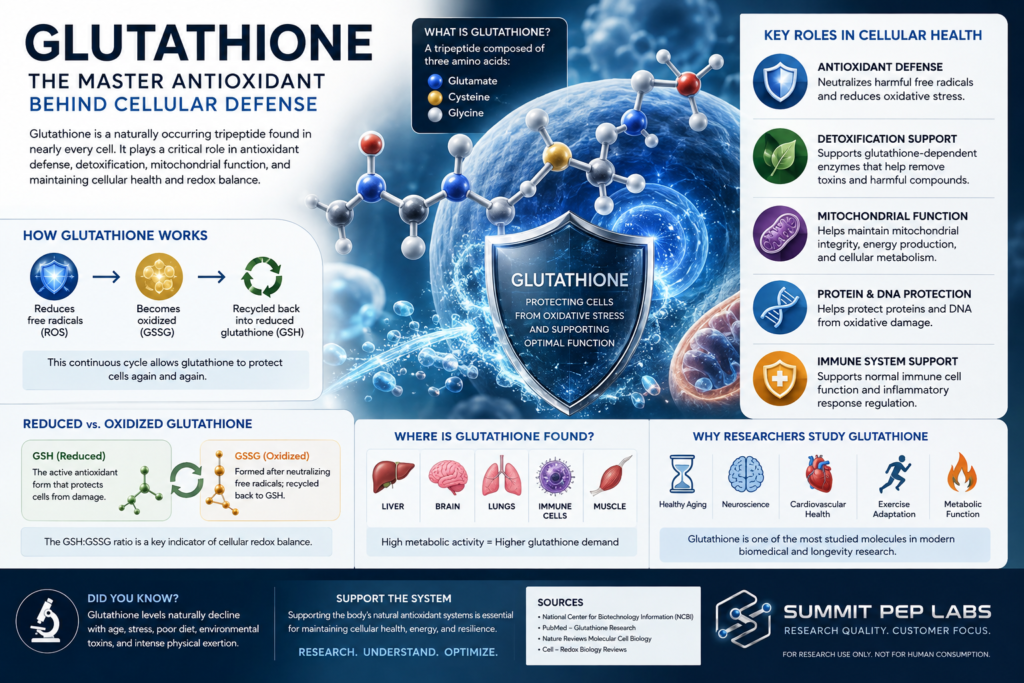
Glutathione is a naturally occurring tripeptide composed of three amino acids:
🧪 Glutamate
🧪 Cysteine
🧪 Glycine
Unlike vitamins or dietary antioxidants, glutathione is produced inside cells, allowing it to participate directly in numerous biological processes.
Researchers continue studying glutathione because of its involvement in antioxidant defense, cellular metabolism, mitochondrial biology, and detoxification pathways.
⚡ Why Do Cells Need Glutathione?
Normal metabolism constantly generates reactive oxygen species.
Although these molecules are a natural byproduct of cellular respiration, excessive amounts can overwhelm a cell’s antioxidant defenses.
Researchers study glutathione because it helps protect against oxidative damage involving:
🧬 DNA
💪 Proteins
🧫 Cell membranes
⚡ Mitochondria
🧠 Cellular signaling proteins
Maintaining this balance—known as redox homeostasis—is essential for healthy cellular function.
🔬 How Glutathione Works
Think of glutathione as a molecular shield.
When unstable free radicals are produced, glutathione donates an electron to stabilize them before they damage surrounding cellular structures.
During this process:
Reduced Glutathione (GSH)
⬇️
Neutralizes Reactive Oxygen Species
⬇️
Becomes Oxidized Glutathione (GSSG)
⬇️
Recycled Back into GSH
This recycling process allows glutathione to protect cells continuously.
⚙️ The Glutathione Cycle
Scientists often describe glutathione as existing in two primary forms.
| Form | Function |
|---|---|
| GSH (Reduced) | Active antioxidant that neutralizes free radicals |
| GSSG (Oxidized) | Form produced after antioxidant activity |
Researchers frequently evaluate the GSH:GSSG ratio when studying cellular oxidative stress.
🔋 Glutathione and Mitochondrial Function
Mitochondria are often called the powerhouses of the cell because they generate ATP—the body’s primary energy source.
However, mitochondria also produce reactive oxygen species during energy production.
Researchers investigate glutathione because it appears to help maintain:
⚡ Mitochondrial integrity
🔋 Cellular energy metabolism
🧬 Mitochondrial enzyme activity
🛡️ Protection against oxidative stress
➡️ Internal Link: Ultimate MOTS-C Research Guide
🧪 Glutathione and Cellular Detoxification
One of glutathione’s best-known functions is its participation in the body’s natural detoxification systems.
Specialized enzymes called Glutathione S-Transferases (GSTs) attach glutathione to certain compounds, making them easier for cells to process and eliminate.
Researchers continue studying this pathway in liver biology and cellular metabolism.
🌐 Cellular Processes Associated with Glutathione
Current laboratory research continues investigating glutathione’s role in:
| Research Area | Why Scientists Study It |
|---|---|
| 🛡️ Antioxidant Defense | Neutralization of reactive oxygen species |
| ⚡ Energy Metabolism | Maintenance of mitochondrial function |
| 🧬 DNA Protection | Reducing oxidative damage |
| 🧫 Protein Stability | Preventing oxidation of cellular proteins |
| 🔬 Cellular Detoxification | Supporting glutathione-dependent enzymes |
| 🧠 Cell Signaling | Maintaining normal redox signaling |
🔥 Glutathione and Oxidative Stress
Oxidative stress occurs when reactive oxygen species accumulate faster than antioxidant systems can neutralize them.
Scientists continue exploring oxidative stress in relation to:
🧓 Healthy aging
🧠 Neuroscience
❤️ Cardiovascular biology
🏃 Exercise physiology
🧬 Cellular metabolism
Because glutathione is one of the body’s primary antioxidants, it remains central to many of these investigations.
🧫 Where Is Glutathione Found?
Although every cell produces glutathione, certain tissues contain especially high concentrations.
These include:
🫀 Liver
🧠 Brain
🫁 Lungs
🦠 Immune cells
⚡ Skeletal muscle
High metabolic activity often corresponds with increased glutathione demand.
📈 Why Researchers Continue Studying Glutathione
Modern research continues examining glutathione in areas including:
🧬 Cellular aging
⚡ Mitochondrial biology
🛡️ Antioxidant systems
🧠 Neurobiology
❤️ Cardiovascular research
🏃 Exercise adaptation
🧪 Metabolic physiology
As interest in cellular health expands, glutathione remains one of the most frequently studied endogenous antioxidants.
🧩 Frequently Asked Questions
Is glutathione a peptide?
Yes. Glutathione is a naturally occurring tripeptide consisting of glutamate, cysteine, and glycine.
Why is glutathione called the “master antioxidant”?
Because it is present in nearly every cell and participates in numerous antioxidant and redox reactions throughout the body.
What is oxidative stress?
Oxidative stress occurs when reactive oxygen species exceed the body’s ability to neutralize them with antioxidant defenses.
Why is glutathione important in research?
Researchers investigate glutathione because of its central role in antioxidant biology, mitochondrial function, detoxification pathways, and cellular signaling.
📚 Suggested Internal Links
Strengthen your topical authority by linking to:
➡️ Ultimate MOTS-C Research Guide
➡️ How Peptides Work: Understanding Cellular Communication
➡️ Peptide Storage & Handling Guide
➡️ What Does 99% HPLC Purity Mean?
➡️ Relevant Glutathione Product Page
📖 External References
Support this article with trusted scientific resources:
- National Center for Biotechnology Information (NCBI) – Glutathione Biology
- PubMed – Glutathione Research
- Nature Reviews – Oxidative Stress and Cellular Biology
- Cell Press – Redox Signaling Reviews
🏁 Final Thoughts
Glutathione is one of the most important naturally occurring molecules involved in maintaining cellular homeostasis. By supporting antioxidant defenses, participating in detoxification pathways, protecting mitochondria, and helping regulate redox signaling, glutathione remains a cornerstone of modern cell biology research.
As scientists continue exploring oxidative stress, metabolism, and healthy aging, glutathione will likely remain one of the most extensively investigated endogenous peptides in biomedical science.