A Deep Dive into Cell Signaling, Receptors, and Molecular Messengers
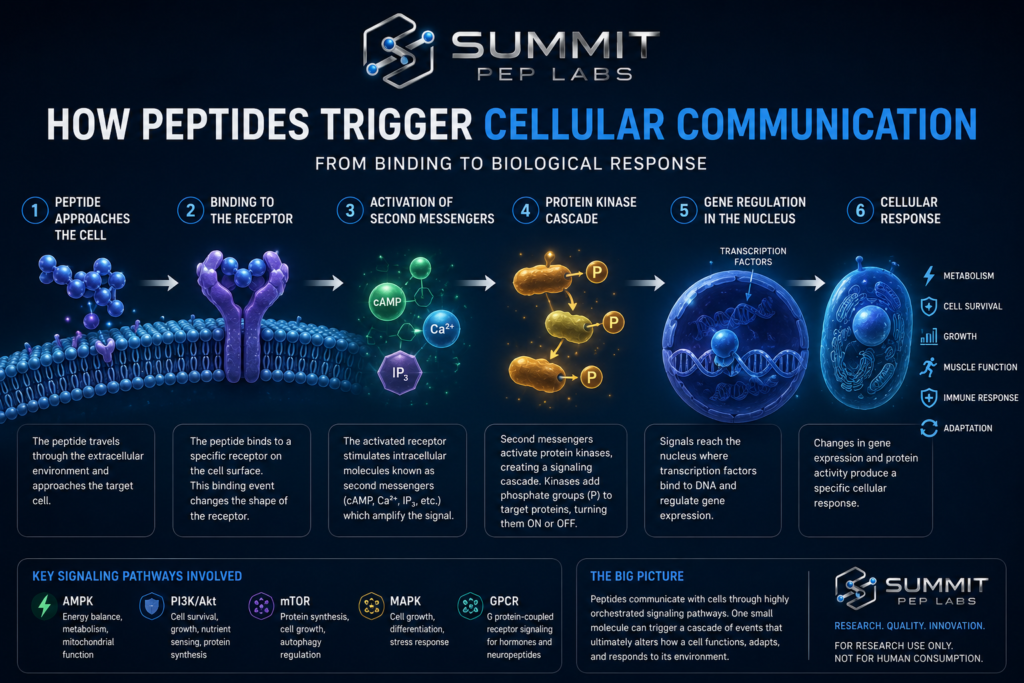
🧬 Inside the Cell: How Peptides Trigger Cellular Communication
We are going to talk about how peptides work. Every second, trillions of cells throughout the human body are exchanging information. Unlike spoken language, these microscopic conversations occur through molecules, receptors, electrical signals, and intricate biochemical pathways.
Among the most fascinating of these molecular messengers are peptides.
Although peptides vary widely in structure and biological function, they all share one common purpose: they communicate information to cells.
Whether researchers are studying metabolism, endocrine biology, mitochondrial function, tissue signaling, or neurobiology, understanding how peptides transmit signals is essential to understanding modern biology.
In this guide, we’ll follow a peptide from the moment it encounters a cell to the complex cascade of events that ultimately changes cellular behavior.
Research Use Only: Products offered by Summit Pep Labs are intended exclusively for laboratory research and are not approved for human consumption or therapeutic use.
🧫 What Is Cellular Communication?
Cells cannot survive in isolation.
They constantly exchange information regarding:
- ⚡ Energy availability
- 🧬 DNA repair
- 🔥 Inflammation
- 💪 Muscle activity
- 🍽 Nutrient availability
- 🧠 Hormonal signals
- 🦠 Environmental stress
Rather than acting independently, cells operate as members of an enormous biological network.
Peptides serve as one category of molecular messengers within that network.
📡 Step 1: A Peptide Arrives at a Cell
Imagine the surface of every cell as the entrance to a highly secure laboratory.
Thousands of specialized proteins cover its surface.
These proteins are called receptors.
Each receptor recognizes only particular molecules.
Think of them like locks.
Each peptide acts as a unique key.
Only the correct key fits the correct lock.
Once binding occurs, the real work begins.
🔑 Step 2: The Receptor Changes Shape
One of the biggest misconceptions is that peptides simply “turn something on.”
Instead, peptide binding changes the physical shape of the receptor.
This structural change activates proteins inside the cell that begin passing along the message.
Scientists call this process:
Signal Transduction
Signal transduction simply means converting an outside signal into an internal cellular response.
🧪 The Major Types of Peptide Receptors
Different peptides activate different receptor families.
| Receptor | Primary Function |
|---|---|
| GPCR | Hormones and neuropeptides |
| Receptor Tyrosine Kinase | Growth signaling |
| Cytokine Receptors | Immune communication |
| Ion Channel Receptors | Electrical signaling |
Many investigational peptides interact with one or more of these receptor systems, depending on their biology.
⚡ Step 3: Second Messengers Amplify the Signal
The initial peptide signal is often too small to directly change the behavior of the entire cell.
Instead, cells use second messengers to amplify the message.
Common examples include:
- cAMP
- Calcium ions (Ca²⁺)
- IP3
- DAG
- cGMP
These molecules spread the signal rapidly throughout the cell, ensuring that one receptor-binding event can influence many downstream processes.
🧬 Step 4: Protein Kinases Take Over
Second messengers activate enzymes known as protein kinases.
Protein kinases regulate proteins by attaching phosphate groups to them.
This process—called phosphorylation—acts like flipping molecular switches.
One activated kinase can trigger another, creating a signaling cascade.
🌐 Major Cellular Signaling Pathways
Several pathways appear repeatedly throughout peptide research.
⚡ AMPK
AMPK functions as the cell’s energy sensor.
Researchers study AMPK because it influences:
- Energy balance
- Glucose utilization
- Fat oxidation
- Mitochondrial activity
📈 PI3K/Akt
The PI3K/Akt pathway plays an important role in:
- Cell survival
- Growth
- Nutrient sensing
- Protein synthesis
🚀 mTOR
mTOR integrates information about nutrients, growth factors, and energy availability.
Scientists investigate mTOR in research involving:
- Cellular growth
- Protein synthesis
- Autophagy
- Metabolism
🧪 MAPK
MAPK signaling helps cells respond to:
- Stress
- Growth signals
- Differentiation
- Environmental changes
🧠 Step 5: The Nucleus Receives the Message
Some signaling pathways eventually reach the nucleus.
Once there, transcription factors influence which genes become more or less active.
Rather than changing DNA itself, the cell adjusts which instructions are read.
This allows cells to adapt to changing conditions.
🧬 Mitochondrial Communication
Recent research has expanded our understanding of cellular communication beyond the cell membrane.
Mitochondria also send signals.
One well-studied example is MOTS-C, a mitochondrial-derived peptide that appears capable of influencing nuclear gene expression during metabolic stress.
This emerging field—known as mitochondrial retrograde signaling—continues to reshape how scientists think about intracellular communication.
📊 One Signal, Many Outcomes
The same peptide can produce different responses depending on:
| Variable | Effect |
|---|---|
| Cell type | Different proteins are expressed |
| Receptor density | Stronger or weaker signaling |
| Metabolic state | Alters pathway activation |
| Gene expression | Changes cellular response |
| Signal duration | Temporary vs. sustained effects |
This complexity explains why peptide biology remains an active area of research.
🔬 Why Researchers Study Cell Signaling
Understanding these pathways helps scientists investigate:
- Endocrine physiology
- Metabolic regulation
- Exercise adaptation
- Immune biology
- Neuroscience
- Mitochondrial function
- Healthy aging
Rather than focusing on a single molecule, researchers examine how entire signaling networks respond.
🧩 Frequently Asked Questions
What is signal transduction?
Signal transduction is the process by which an external signal, such as peptide binding, is converted into internal cellular responses.
Do all peptides work the same way?
No. Different peptides interact with different receptors and signaling pathways, producing distinct biological responses.
What are second messengers?
Second messengers are intracellular molecules—such as cAMP or calcium ions—that amplify and distribute signals inside the cell.
Why is cellular communication important?
Without coordinated signaling, cells cannot regulate growth, metabolism, immune responses, or adaptation to environmental changes.
📚 Suggested Internal Links
- Ultimate MOTS-C Research Guide
- Tesamorelin Research Guide
- Retatrutide Research Guide
- What Is Lyophilization?
- What Does 99% HPLC Purity Mean?
- Peptide Storage & Handling Guide
- How Scientists Develop New Peptides
- Relevant product pages where appropriate
📖 External References
🧬 General Cell Signaling
NCBI Bookshelf – Cell Signaling (Excellent overview)
Cell Signaling – The Cell: A Molecular Approach (NCBI Bookshelf)
A fantastic introduction to:
- Cell communication
- Receptors
- Signal transduction
- Gene regulation
- Cellular responses
NCBI Bookshelf – Pathways of Intracellular Signal Transduction
Pathways of Intracellular Signal Transduction (NCBI Bookshelf)
Covers:
- Second messengers
- Protein kinases
- Intracellular signaling cascades
- Transcription factors
🔬 Nature Reviews Molecular Cell Biology
GPCR Signaling Review
Seven-transmembrane receptors (Nature Reviews Molecular Cell Biology)
One of the classic reviews covering:
- GPCR activation
- G proteins
- cAMP signaling
- Receptor biology
🏁 Final Thoughts
Cellular communication is one of the foundations of modern biology. Every peptide, hormone, and signaling molecule contributes to an intricate network that allows cells to sense their environment, coordinate with neighboring tissues, and adapt to changing conditions. By understanding receptors, signal transduction, second messengers, and gene regulation, researchers gain deeper insight into how biological systems function at the molecular level.
Whether studying mitochondrial peptides such as MOTS-C, growth hormone–releasing peptides like Tesamorelin, or investigational compounds targeting metabolic pathways, the underlying principle remains the same: cells communicate through highly organized signaling networks that convert molecular messages into biological responses.