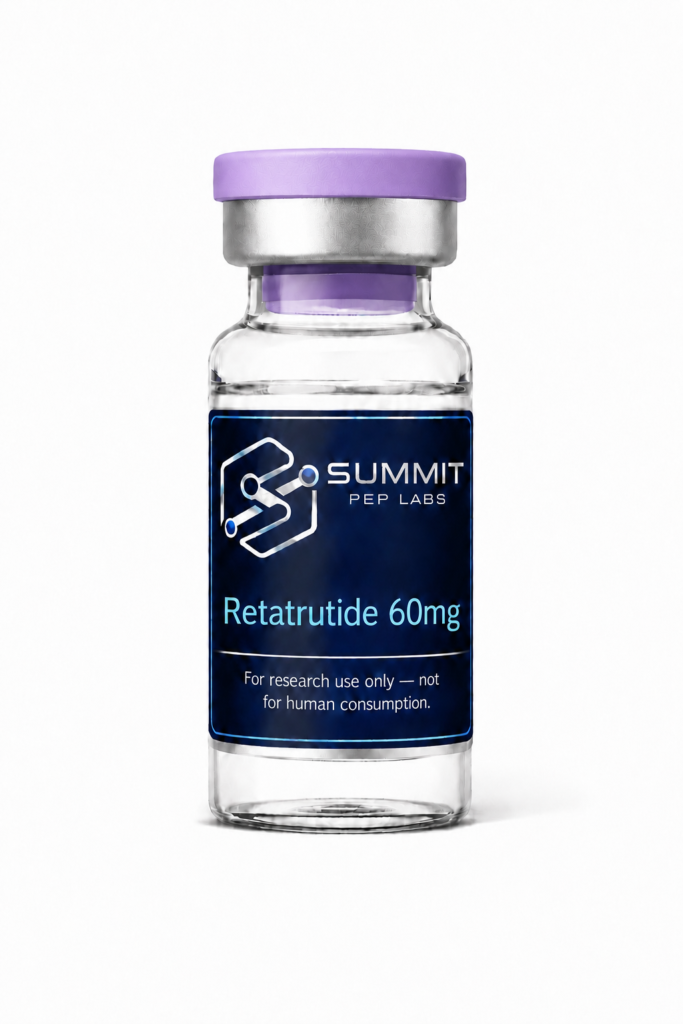
🧬 Retatrutide vs. Cagrilintide: Understanding Two Promising Research Peptides
As peptide research continues to evolve, two compounds attracting significant scientific interest are Retatrutide and Cagrilintide. While both are being investigated for their effects on metabolism and energy regulation, they work through very different biological pathways.
Understanding those differences is important for researchers studying obesity, appetite regulation, insulin signaling, and metabolic health.
In this guide, we’ll compare their mechanisms of action, explain how they differ, review current research, and discuss why some investigators are interested in studying them individually or in combination.
⚠️ Research Use Only: Summit Pep Labs products are intended strictly for laboratory research. They are not approved for human consumption, diagnosis, or treatment.
📊 Quick Comparison
| Feature | 🧬 Retatrutide | 🧪 Cagrilintide |
|---|---|---|
| Drug Class | Triple receptor agonist | Amylin analog |
| Primary Targets | GLP-1, GIP, Glucagon | Amylin receptor |
| Appetite Research | ✅ Yes | ✅ Yes |
| Gastric Emptying Research | ✅ Yes | ✅ Yes |
| Energy Expenditure Research | ✅ Investigated | Limited |
| Blood Glucose Research | ✅ Yes | Indirect |
| Current Research Focus | Obesity & metabolic disease | Appetite regulation & obesity |
🧬 What Is Retatrutide?
Retatrutide is an investigational peptide that activates three different hormone receptors simultaneously:
✅ GLP-1 receptor
✅ GIP receptor
✅ Glucagon receptor
Because it acts on three pathways, it is commonly referred to as a triple agonist.
Researchers believe this multi-receptor approach may influence:
- 🍽️ Appetite regulation
- ⚡ Energy expenditure
- 🩸 Glucose metabolism
- 🧬 Fat metabolism
- 🏃 Body weight regulation
This broad mechanism has made Retatrutide one of the most closely studied metabolic peptides in recent years.
🧠 How Retatrutide Works
Unlike earlier GLP-1 compounds that activate only one receptor, Retatrutide stimulates three hormonal signaling systems simultaneously.
| Receptor | Research Interest |
|---|---|
| 🟢 GLP-1 | Appetite regulation and glucose signaling |
| 🔵 GIP | Insulin response and metabolic regulation |
| 🔴 Glucagon | Energy expenditure and fat metabolism |
Researchers believe activating all three pathways together may produce effects that differ from single-receptor therapies.
🧪 What Is Cagrilintide?
Cagrilintide is a long-acting amylin analog.
Amylin is a naturally occurring hormone released by pancreatic beta cells alongside insulin after eating.
Researchers study amylin because it appears to influence:
🍽️ Satiety signals
⏳ Gastric emptying
🧠 Appetite regulation
🥗 Meal size
Unlike Retatrutide, Cagrilintide does not directly activate GLP-1 receptors.
Instead, it mimics the activity of amylin.
🧠 How Cagrilintide Works
After meals, amylin normally works alongside insulin to help regulate digestion and fullness.
Cagrilintide was designed to imitate these natural actions.
Researchers are studying whether amylin receptor activation may:
✅ Increase feelings of fullness
✅ Reduce food intake in research models
✅ Slow stomach emptying
✅ Influence body weight regulation
⚖️ Retatrutide vs. Cagrilintide: Mechanism Comparison
| Function | Retatrutide | Cagrilintide |
|---|---|---|
| GLP-1 receptor | ✅ | ❌ |
| GIP receptor | ✅ | ❌ |
| Glucagon receptor | ✅ | ❌ |
| Amylin receptor | ❌ | ✅ |
| Multi-hormone signaling | ✅ | ❌ |
| Mimics natural amylin | ❌ | ✅ |
The most important distinction is that Retatrutide activates three separate receptors, while Cagrilintide primarily targets the amylin receptor.
🔬 Why Researchers Are Interested in Combining Them
One of the most exciting areas of metabolic research is the possibility of combining peptides that work through different biological pathways.
Because Retatrutide and Cagrilintide target different receptors, researchers are interested in exploring whether they may have complementary effects in preclinical and clinical studies.
Potential areas of investigation include:
- 🧬 Appetite regulation
- ⚡ Energy balance
- 🍽️ Satiety signaling
- 🩸 Glucose regulation
- 🔥 Body composition
At this time, research into combination approaches is ongoing, and no conclusions should be drawn outside of published scientific evidence.
📈 Current Research Landscape
Retatrutide has generated attention because of its triple agonist mechanism, while Cagrilintide has been studied both on its own and in combination with GLP-1 receptor agonists.
Current areas of investigation include:
- Obesity research
- Metabolic syndrome
- Appetite regulation
- Insulin sensitivity
- Energy homeostasis
Much of this work remains investigational.
🧬 Which Peptide Is More Complex?
From a receptor signaling perspective:
🏆 Retatrutide has the more complex mechanism because it activates three separate hormonal pathways simultaneously.
Cagrilintide has a narrower focus, primarily targeting amylin receptors associated with satiety and digestion.
Neither approach is inherently “better”—they are simply designed to investigate different biological mechanisms.
📚 Related Research Articles
Continue exploring peptide science:
🧬 Retatrutide Research Guide
💉 Is Retatrutide Like Ozempic?
⚖️ Retatrutide vs. Tirzepatide
🔬 NAD+ Research Guide
✨ GHK-Cu Research Guide
🛒 Explore Research Peptides
Summit Pep Labs offers research-grade peptides intended exclusively for laboratory use.
Popular research compounds include:
- 🧬 Retatrutide
- 🧬 Cagrilintide
- 🧬 NAD+
- 🧬 MOTS-C
- 🧬 GHK-Cu
- 🧬 BPC-157 + TB-500
❓Frequently Asked Questions
🤔 Is Retatrutide the same as Cagrilintide?
No. Retatrutide is a triple receptor agonist that targets GLP-1, GIP, and glucagon receptors, while Cagrilintide is an amylin analog that primarily acts on amylin receptors.
🤔 Why are researchers comparing them?
Although both compounds are being studied for obesity and metabolic research, they influence different biological pathways, making comparisons valuable for understanding their distinct mechanisms.
🤔 Can Retatrutide and Cagrilintide be studied together?
Researchers are investigating combinations of compounds with complementary mechanisms. Studies examining such approaches are ongoing, and conclusions should be based on published scientific evidence.
🤔 Which works on more receptors?
Retatrutide targets three receptors, whereas Cagrilintide primarily targets the amylin receptor.
🌐 Scientific Resources
For readers interested in exploring the science further:
- PubMed – https://pubmed.ncbi.nlm.nih.gov/
- National Center for Biotechnology Information (NCBI) – https://www.ncbi.nlm.nih.gov/
- Lilly Retatrutide Clinical Research – https://clinicaltrials.gov/
- Novo Nordisk Research – https://www.novonordisk.com/
🎯 Final Thoughts
Retatrutide and Cagrilintide represent two distinct approaches in metabolic peptide research. Retatrutide investigates the effects of activating GLP-1, GIP, and glucagon receptors, while Cagrilintide focuses on amylin receptor signaling involved in satiety and gastric function.
As scientific understanding continues to evolve, comparing these mechanisms helps researchers better understand how different hormonal pathways contribute to metabolism and energy regulation.
Whether you’re researching Retatrutide, Cagrilintide, or other investigational peptides, understanding each compound’s mechanism is essential for interpreting current and future research.