Cagrilintide has emerged as one of the most closely watched investigational peptides in metabolic and obesity research.
Unlike traditional GLP-1 receptor agonists, cagrilintide is a long-acting amylin analogue designed to interact with the amylin receptor system. Researchers are investigating how this pathway influences appetite, satiety, food intake, body weight, and metabolic regulation.
Interest in cagrilintide has increased significantly as researchers investigate both cagrilintide as a standalone compound and its combination with semaglutide in CagriSema.
So what exactly is cagrilintide, how does the amylin pathway work, and why has this peptide attracted so much attention?
Let’s take a closer look. 🔬
🧬 What Is Cagrilintide?
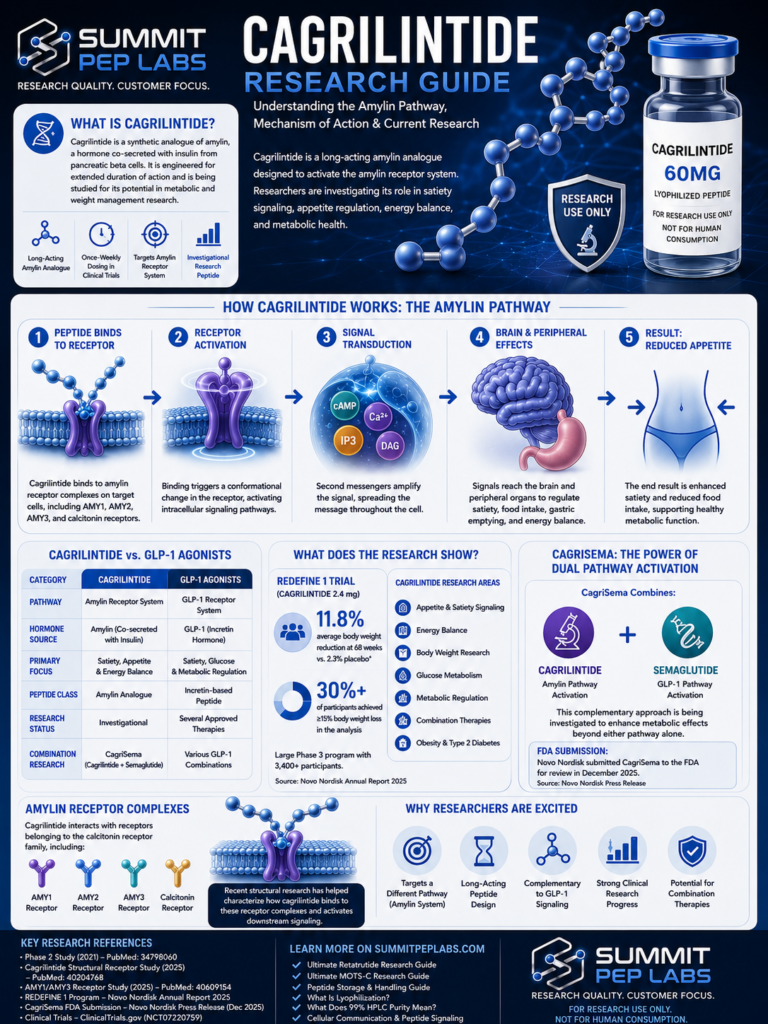
Cagrilintide is a long-acting synthetic analogue of amylin, a peptide hormone naturally produced by pancreatic beta cells alongside insulin.
Amylin plays an important role in regulating:
- 🍽️ Food intake
- 🧠 Satiety signaling
- 🩸 Post-meal glucose regulation
- 🥗 Gastric emptying
- ⚡ Energy balance
Cagrilintide was engineered to produce longer-lasting activity than naturally occurring amylin, making it particularly interesting for researchers studying sustained amylin receptor signaling.
The FDA’s substance database classifies cagrilintide as a peptide and an amylin analogue.
🧠 Understanding Amylin Signaling
To understand cagrilintide, it helps to understand amylin first.
Amylin is released from pancreatic beta cells when nutrients enter the bloodstream.
It works alongside other metabolic signals to help the body regulate what happens after eating.
One important function of amylin is communicating with the brain regarding energy intake and satiety.
Think of the system as a biological feedback loop:
Food intake → nutrient sensing → hormone release → brain signaling → satiety → reduced food intake
Cagrilintide is designed to interact with this signaling system.
🔑 How Does Cagrilintide Work?
Cagrilintide interacts with receptors belonging to the calcitonin receptor family, including amylin receptor complexes.
Researchers have specifically investigated its interactions with:
- AMY1 receptors
- AMY2 receptors
- AMY3 receptors
- Calcitonin receptors
Recent structural research has helped characterize how cagrilintide binds to these receptor complexes and how that binding influences receptor activation.
This is important because receptor activation is only the beginning.
Once the receptor is activated, downstream cellular signaling can influence neuronal pathways involved in appetite and energy regulation.
🍽️ Cagrilintide and Satiety
One of the primary reasons researchers are interested in cagrilintide is its relationship with satiety signaling.
Natural amylin is known to contribute to the feeling of fullness following food intake.
Cagrilintide is being investigated as a way of producing a longer-lasting version of this biological signaling.
In the original phase 2 clinical trial, researchers specifically evaluated cagrilintide’s effects on body weight, safety, and tolerability in adults with overweight or obesity.
The study evaluated several once-weekly doses of cagrilintide and compared them with placebo and liraglutide.
This was an important early clinical milestone because it demonstrated that the amylin pathway could be investigated as a potential standalone target for weight-management research.
📊 What Does the Research Show?
Cagrilintide research has progressed considerably since the early clinical studies.
One of the more important developments has been the REDEFINE 1 program.
According to Novo Nordisk’s 2025 annual report, a cagrilintide 2.4 mg arm in REDEFINE 1 produced an average 11.8% reduction in body weight at 68 weeks, compared with 2.3% for placebo in the reported analysis.
More than 30% of participants receiving cagrilintide achieved at least 15% weight loss in that analysis.
These results are particularly interesting because they suggest that amylin signaling may represent an important metabolic pathway independent of traditional GLP-1 signaling.
However, it is important to distinguish research findings from approved medical treatment.
Cagrilintide remains investigational.
🧪 Cagrilintide vs. GLP-1 Research
One of the most interesting aspects of cagrilintide research is that it targets a different biological system from traditional GLP-1 receptor agonists.
| Feature | Cagrilintide | GLP-1 Receptor Agonists |
|---|---|---|
| Primary pathway | Amylin receptor system | GLP-1 receptor |
| Biological role | Satiety & energy regulation | Satiety & metabolic regulation |
| Primary research interest | Appetite and energy balance | Appetite, glucose & metabolism |
| Molecular class | Amylin analogue | Incretin-based peptide |
| Research status | Investigational | Several agents approved |
| Combination research | CagriSema | Various combinations |
This distinction is one reason cagrilintide has become so interesting to researchers.
Rather than simply creating another GLP-1 analogue, scientists are investigating whether different metabolic signaling systems can complement one another.
🔬 Why Is CagriSema So Interesting?
Perhaps the biggest development surrounding cagrilintide is CagriSema.
CagriSema combines:
Cagrilintide + Semaglutide
The scientific rationale is relatively straightforward.
Cagrilintide activates the amylin pathway, while semaglutide activates the GLP-1 receptor pathway.
Researchers are therefore investigating whether targeting these complementary pathways simultaneously can produce different or enhanced metabolic effects compared with either pathway alone.
The REDEFINE 1 program enrolled more than 3,400 participants and investigated CagriSema alongside cagrilintide and semaglutide comparator groups.
In December 2025, Novo Nordisk announced that it had submitted CagriSema to the FDA for review.
That submission represents an important milestone for the amylin research field.
🧠 Cagrilintide and the Brain
The amylin system is particularly interesting because much of its appetite-related activity involves the central nervous system.
Researchers have been investigating which receptor populations are responsible for cagrilintide’s effects.
A 2025 study published in eBioMedicine investigated the role of AMY1 and AMY3 receptors in cagrilintide-associated body-weight effects using receptor knockout models. The researchers found that removing RAMP1 and RAMP3 impaired cagrilintide’s potency in their experimental model.
This type of research helps scientists move beyond simply asking:
“Does cagrilintide affect body weight?”
and toward a more important question:
“Which receptors and neural circuits are responsible for the observed effects?”
That distinction is critical for understanding peptide pharmacology.
⚡ Cagrilintide and Metabolic Research
Researchers are also interested in how amylin signaling fits into the larger metabolic network.
Metabolic regulation isn’t controlled by a single hormone.
Instead, multiple signaling systems communicate with one another.
These include:
🧬 Insulin
🧬 Glucagon
🧬 GLP-1
🧬 GIP
🧬 Amylin
🧬 Leptin
🧬 Ghrelin
This makes cagrilintide particularly interesting because it represents another component of the body’s broader energy-regulation network.
🔬 Cagrilintide Research Beyond Weight Regulation
While body-weight research receives much of the attention, researchers are also examining cagrilintide in broader metabolic contexts.
Current clinical research includes investigations involving:
- Metabolic regulation
- Energy balance
- Appetite signaling
- Obesity
- Overweight populations
- Type 2 diabetes
- Combination metabolic therapies
ClinicalTrials.gov currently lists ongoing phase 3 research involving cagrilintide in people with overweight or obesity and type 2 diabetes.
Researchers are also investigating cagrilintide in combination with semaglutide.
📈 Why Researchers Are Paying Attention to Cagrilintide
There are several reasons cagrilintide has become such an important research target.
1️⃣ It Targets a Different Pathway
Cagrilintide doesn’t simply replicate GLP-1 signaling.
It targets the amylin receptor system.
2️⃣ Amylin Is a Naturally Occurring Metabolic Hormone
The underlying biology isn’t new.
Amylin is already part of normal human physiology.
3️⃣ The Peptide Has a Long-Acting Design
Researchers developed cagrilintide specifically as a longer-acting amylin analogue.
4️⃣ Combination Research Is Expanding
The development of CagriSema demonstrates the growing interest in targeting multiple complementary metabolic pathways simultaneously.
5️⃣ Clinical Research Has Progressed
Cagrilintide has moved from early-stage investigation into large phase 3 programs.
That makes it one of the more advanced investigational compounds within the amylin field.
🧪 Cagrilintide Research and Peptide Quality
For laboratory researchers working with peptide materials, analytical characterization and storage are important considerations.
Lyophilized peptides can be sensitive to environmental conditions including:
- 💧 Moisture
- 🌡️ Temperature
- 💡 Light
- ⏱️ Long-term storage conditions
Researchers should consult appropriate laboratory protocols, analytical documentation, and manufacturer-specific handling information.
These articles also create useful topical connections for search engines while helping readers understand the science behind peptide research materials.
📚 Cagrilintide Research: Important Studies
For readers who want to explore the scientific literature directly, several publications provide useful starting points.
🧬 Phase 2 Cagrilintide Study
The landmark 2021 Lancet phase 2 study investigated once-weekly cagrilintide for weight management in adults with overweight or obesity.
🔬 Cagrilintide Receptor Research
A 2025 study examined the structural interactions between cagrilintide and amylin/calcitonin receptor complexes.
Read the receptor study on PubMed
🧠 Cagrilintide and Brain Amylin Receptors
Researchers have also investigated the role of AMY1 and AMY3 receptors in cagrilintide-associated body-weight effects.
Read the 2025 eBioMedicine study on PubMed
🧪 Current Clinical Research
ClinicalTrials.gov provides an up-to-date database of registered cagrilintide clinical trials, including ongoing phase 3 research.
View current cagrilintide trials on ClinicalTrials.gov
🧩 Frequently Asked Questions About Cagrilintide
What is cagrilintide?
Cagrilintide is a long-acting synthetic analogue of the pancreatic hormone amylin and is being investigated for metabolic and weight-management applications.
Is cagrilintide a GLP-1?
No.
Cagrilintide is an amylin analogue, not a GLP-1 receptor agonist.
What is CagriSema?
CagriSema is an investigational combination of cagrilintide and semaglutide designed to target amylin and GLP-1 signaling pathways simultaneously. Novo Nordisk submitted CagriSema to the FDA in December 2025.
Is cagrilintide FDA approved?
Cagrilintide itself remains investigational. ClinicalTrials.gov describes it as a new investigational medicine.
Why is cagrilintide important in peptide research?
Cagrilintide provides researchers with an opportunity to study the amylin signaling pathway, an important component of appetite and metabolic regulation that differs from the GLP-1 pathway.
🔗 Cagrilintide product page
Related Research Articles
➡️ Ultimate Retatrutide Research Guide
➡️ Ultimate MOTS-C Research Guide
➡️ Cellular Communication & Peptide Signaling
➡️ Peptide Storage & Handling Guide
➡️ What Does 99% HPLC Purity Mean?
🏁 Final Thoughts
Cagrilintide represents an important development in modern peptide and metabolic research.
Rather than focusing exclusively on GLP-1 signaling, researchers are investigating the amylin pathway and its role in appetite, satiety, energy balance, and metabolic regulation.
The progression from early phase 2 studies to large phase 3 programs—and the development of CagriSema—demonstrates how significant the amylin pathway has become within metabolic research.
For researchers, the most interesting question may ultimately be how different metabolic signaling pathways interact with one another.
GLP-1. GIP. Amylin. Glucagon.
The future of metabolic research may depend less on studying these pathways individually and more on understanding how they communicate as an integrated biological network.